

Red-eared slider · Gentle handling

How do I handle a red-eared slider safely?

Handle a red-eared slider only when needed, holding both shell sides behind the forelegs while supporting the body. Keep it low, brief, and away from your face.

Sliders are better observed swimming and basking than carried or petted. Necessary handling should be secure and calm.

Use the practical checks
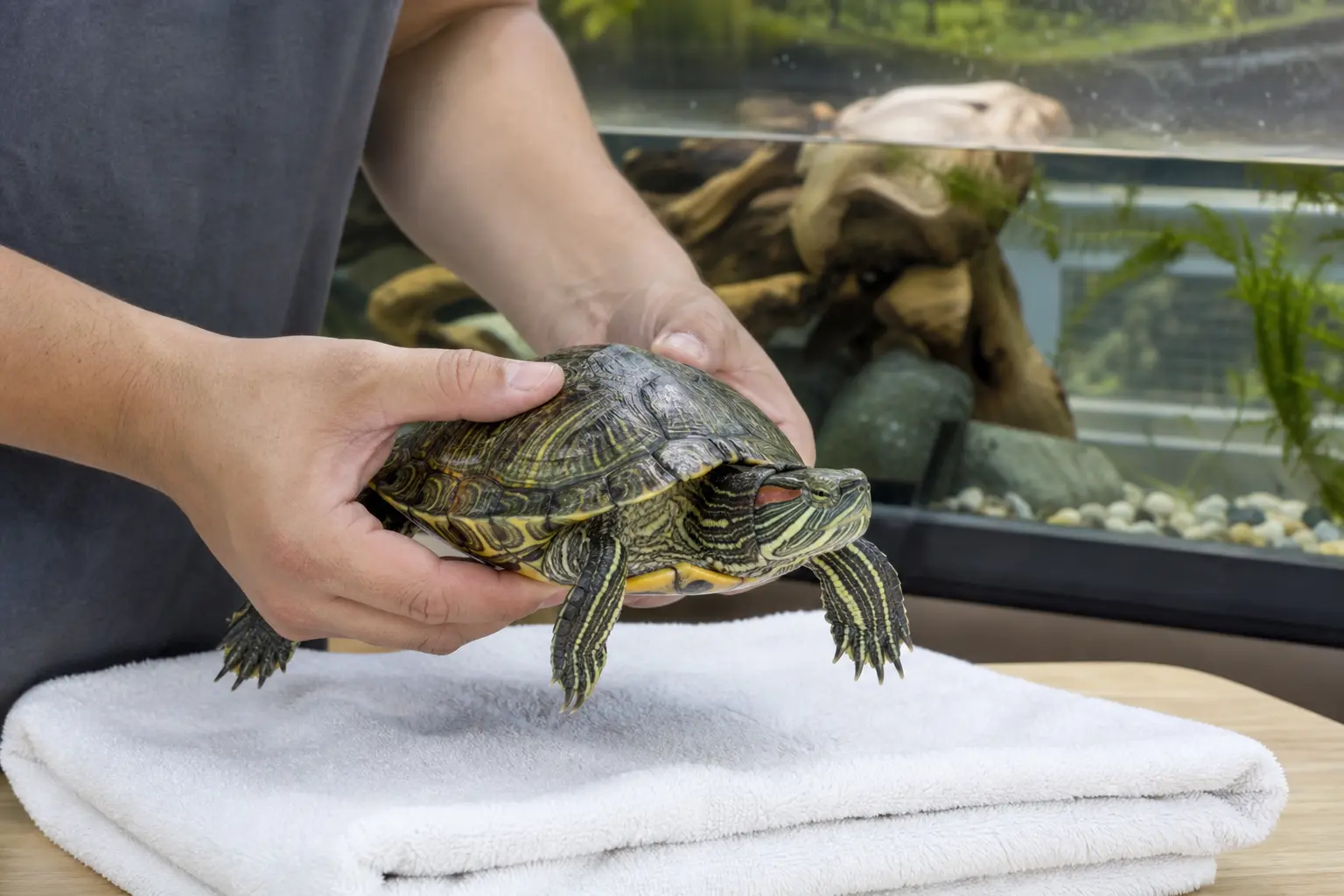
Adult red-eared slider held low over a towel with both hands gripping the shell sides securely behind the forelegs and supporting the body.

The short answer

Use a secure two-handed shell hold only when needed for red-eared sliders

Handle a red-eared slider only when needed, holding both shell sides behind the forelegs while supporting the body. Keep it low, brief, and away from your face.

Adult home
Enough open water to swim freely; RSPCA planning uses about 80 L per 5 cm of shell, or roughly 400 L for a 25 cm adult
Warm zone
Completely dry basking zone 30–35°C (86–95°F)
Cool and night
Water about 25°C (77°F) for hatchlings, decreasing toward 22°C (72°F) for adults; All visible lights off; maintain safe water temperature with a guarded thermostat-controlled aquarium heater when needed
Humidity
Do not chase an ambient percentage: prioritize clean dechlorinated water, low ammonia and nitrite, powerful filtration, ventilation, and a fully dry basking area
UVB
A measured UVI gradient of 3.0–5.0 across the basking zone down to zero in shade, with no glass or plastic blocking the lamp
Food
A varied omnivorous menu built around quality aquatic-turtle food, safe plants, and appropriate animal foods, with calcium guidance

The honest fit

Would the adult routine work in your home?

Do this

  • Work over a low soft surface after the slider has settled.
  • Grip both shell sides securely and support the body close to the floor.
  • Keep fresh water and monitor red-eared slider behavior every day.
  • Record changes so a reptile veterinarian receives useful evidence.

Avoid this

  • Do not flip, dangle, squeeze, or lift by a leg or tail.
  • Do not continue after backing away or frantic escape attempts.
  • Do not copy another reptile species' setup.
  • Do not treat a persistent health change as a shopping problem.
01

Prepare the route first

Use handling for health checks, tank maintenance, and transport after the turtle has settled. Place the destination carrier or secure container within reach before lifting.

Wash and dry your hands, close the room, remove other pets, and work over a towel-covered surface. Never let a turtle roam near stairs, furniture edges, doors, or food-preparation areas.

Adult red-eared slider basking completely out of the water with its oval patterned shell, striped face and limbs, and distinct red ear patch in clear view.
02

Stay behind the head

For this species, pick up only when needed by both shell sides behind the forelegs, support the body, keep fingers away from the head, and stay low over a towel. A slider can reach, kick, scratch, and bite farther than expected.

Do not hold by the tail or a limb, squeeze the shell, flip the turtle, or keep it out of temperature-controlled care for casual interaction. Return it if struggling escalates.

Alert adult red-eared slider on a broad dry basking platform above clean deep water with its olive shell, striped face, and red ear patch in clear view.
03

Treat hygiene as part of handling

Tank water and equipment can carry Salmonella even when the turtle looks healthy. Wash hands with soap and running water after every contact and keep aquarium tools out of kitchens.

Pain, a cracked shell, bleeding, weakness, abnormal swimming, swollen eyes, breathing changes, or sudden inability to use a limb is a reason to stop and contact a reptile veterinarian.

Keep deciding

See the complete care picture

Sources and further reading