

Rosy boa · Gentle handling

How do I handle a rosy boa safely?

Support a rosy boa across two hands and keep handling brief. Wait at least 24 hours after feeding, avoid shed, and stop at firm withdrawal or a defensive S posture.

Calm handling begins after the snake has settled and ends before support, temperature, or body language deteriorates.

Use the practical checks
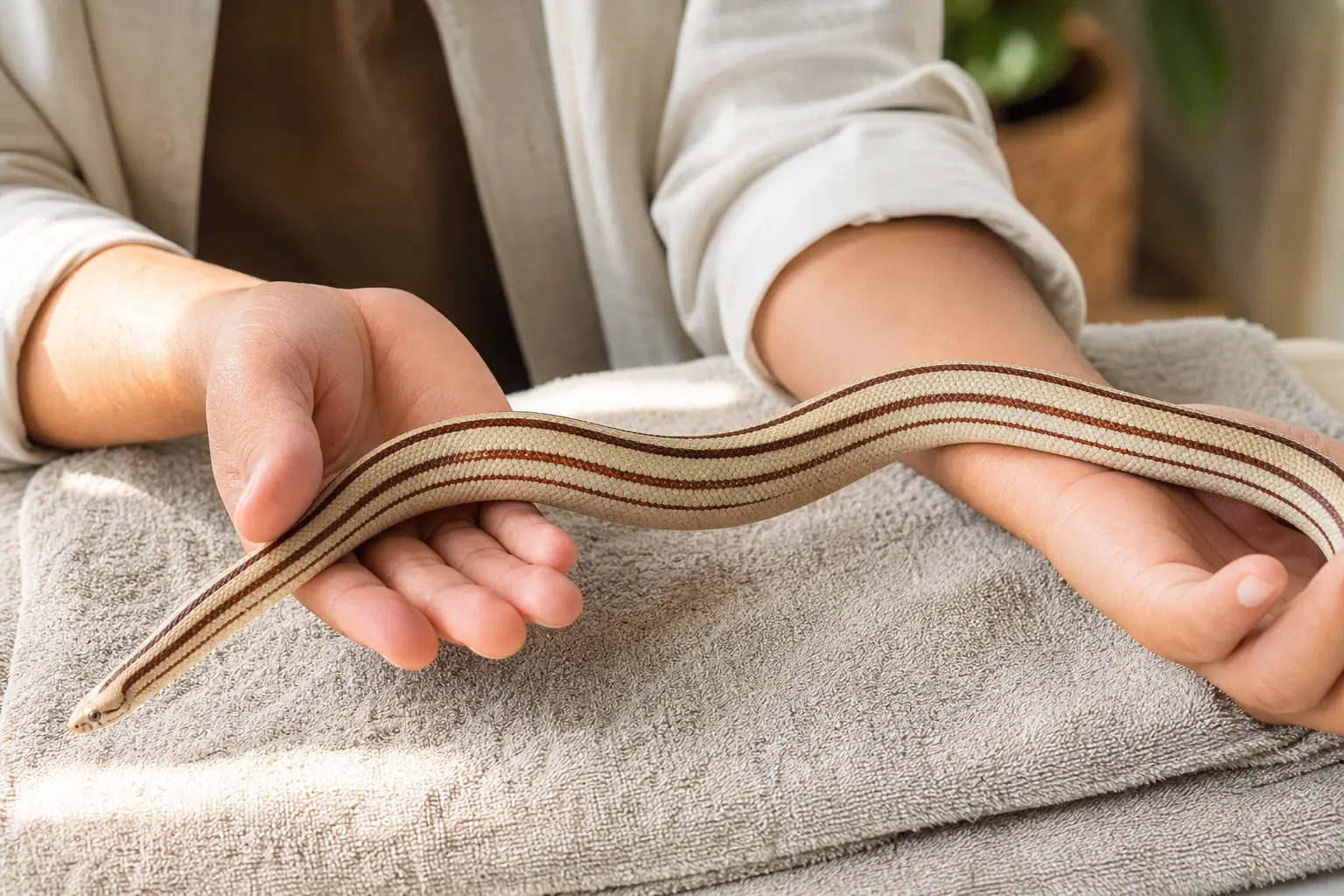
Adult rosy boa moving calmly across two open hands and forearms with its stout body continuously supported.

The short answer

Support the whole snake and respect feeding and shed pauses for rosy boas

Support a rosy boa across two hands and keep handling brief. Wait at least 24 hours after feeding, avoid shed, and stop at firm withdrawal or a defensive S posture.

Adult home
At least the snake's full length by half its length by half its length; commonly 91 × 46 × 46 cm (36 × 18 × 18 in), up to 120 × 60 × 60 cm for a 112 cm adult
Warm zone
Basking surface about 29–32°C (85–90°F)
Cool and night
Cool zone about 24–27°C (75–80°F), with a sheltered cooler retreat; All visible lights and routine heat off; a healthy animal can tolerate a measured drop toward 16°C (60°F)
Humidity
About 40–60%, generally below 60% ambient, with a clean cool humid hide, fresh water, airflow, and a mostly dry enclosure
UVB
Low-intensity linear UVB over the warm side, measured around UVI 2.0–3.0 at the basking area, with complete shade
Food
Appropriately sized frozen-thawed whole rodents offered with long tongs; never use live prey as the routine plan

The honest fit

Would the adult routine work in your home?

Do this

  • Work over a low soft surface after the snake has settled.
  • Lift with two points of support and let the body move freely.
  • Keep fresh water and monitor rosy boa behavior every day.
  • Record changes so a reptile veterinarian receives useful evidence.

Avoid this

  • Do not chase, pin, grip the neck, or let the body hang from one hand.
  • Do not continue after backing away or frantic escape attempts.
  • Do not copy another reptile species' setup.
  • Do not treat a persistent health change as a shopping problem.
01

Start after settling

Give a new rosy boa at least the first week to establish hiding, drinking, and normal activity. Begin only after the enclosure is stable and the snake is not digesting or entering shed.

Wash and dry your hands, remove prey scent, close the room, exclude other pets, and work over a low soft surface. A head drawn back into an S shape means leave the snake alone.

Adult rosy boa resting across pale desert granite with its complete sturdy gray-tan body, three muted rosy stripes, and small blunt head in clear view.
02

Lift with two points of support

For this species, scoop from below with one hand near the front third and another supporting the rest, keep the full body low, and pause at least 24 hours after feeding. Let the stout body move through your hands instead of gripping the neck, tail, or coils.

Keep sessions brief depending on room temperature. Return the snake while it remains calm and before it cools; never let the body dangle from one hand.

Alert adult rosy boa exploring a secure dry rocky habitat with its stout cream body, three reddish-brown lengthwise stripes, small blunt head, and smooth scales in view.
03

Protect digestion and hygiene

Wait at least 24 hours after every meal because premature handling can cause regurgitation. Avoid unnecessary handling during shed, when vision and defensive behavior may change.

Wash hands with soap and water afterward. Pain, weakness, poor muscle tone, wheezing, swelling, an injury, or sudden persistent defensiveness is a reason to stop and seek qualified advice.

Keep deciding

See the complete care picture

Sources and further reading