

Rosy boa · Stuck shed

Why is my rosy boa having stuck shed?

A rosy boa should shed in one complete piece. Check the empty shed for both eye caps and the tail tip, correct the habitat, and never pull attached skin.

An incomplete shed is evidence to review—not skin to peel from the snake.

Use the practical checks
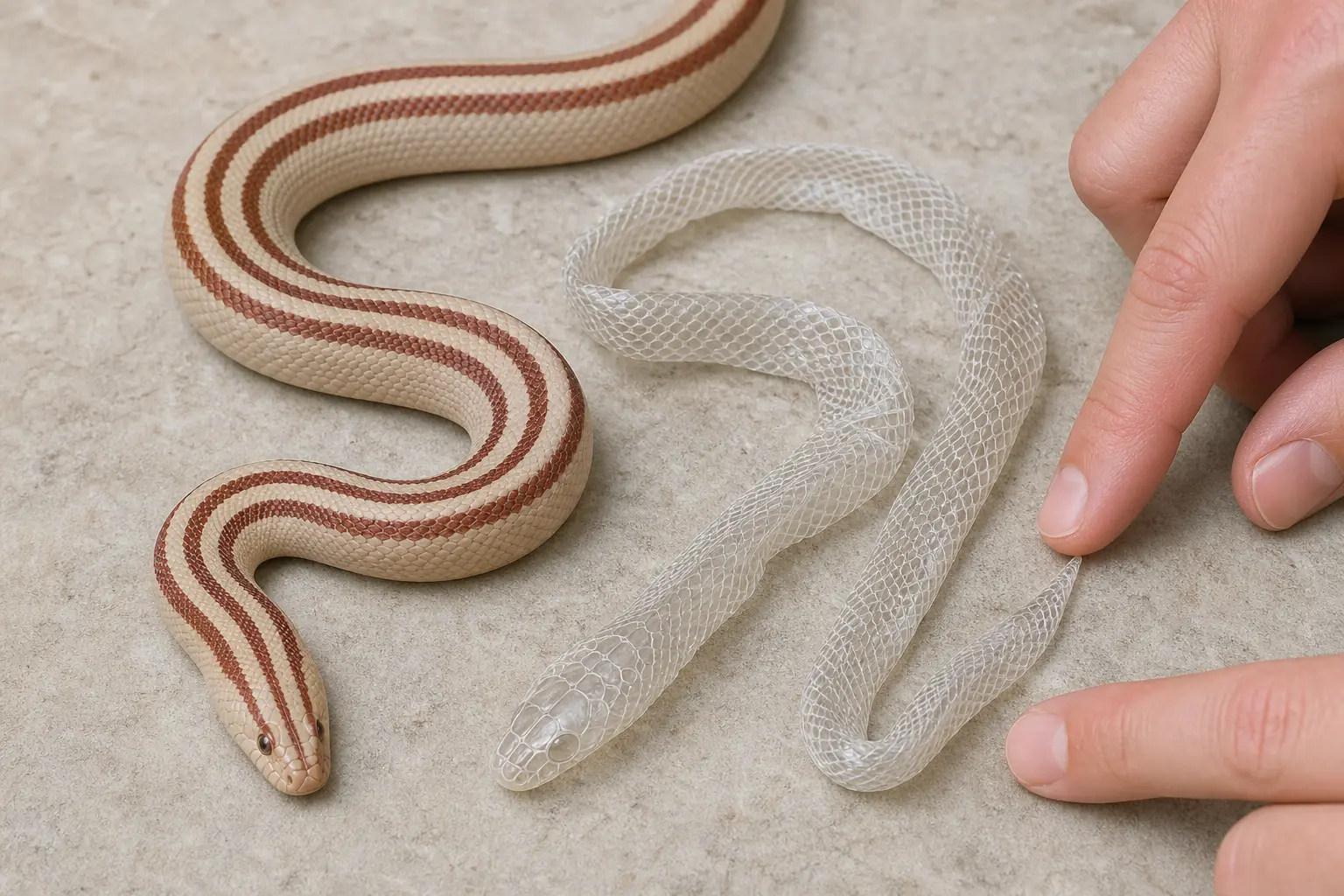
Adult rosy boa beside a complete translucent shed skin while a keeper checks the empty shed for both eye caps and the tail tip.

The short answer

Check the complete shed and correct the conditions for rosy boas

A rosy boa should shed in one complete piece. Check the empty shed for both eye caps and the tail tip, correct the habitat, and never pull attached skin.

Adult home
At least the snake's full length by half its length by half its length; commonly 91 × 46 × 46 cm (36 × 18 × 18 in), up to 120 × 60 × 60 cm for a 112 cm adult
Warm zone
Basking surface about 29–32°C (85–90°F)
Cool and night
Cool zone about 24–27°C (75–80°F), with a sheltered cooler retreat; All visible lights and routine heat off; a healthy animal can tolerate a measured drop toward 16°C (60°F)
Humidity
About 40–60%, generally below 60% ambient, with a clean cool humid hide, fresh water, airflow, and a mostly dry enclosure
UVB
Low-intensity linear UVB over the warm side, measured around UVI 2.0–3.0 at the basking area, with complete shade
Food
Appropriately sized frozen-thawed whole rodents offered with long tongs; never use live prey as the routine plan

The honest fit

Would the adult routine work in your home?

Do this

  • Inspect the shed's eye caps and tail tip after a shed.
  • Correct temperature, hydration, and the species moisture pattern.
  • Keep fresh water and monitor rosy boa behavior every day.
  • Record changes so a reptile veterinarian receives useful evidence.

Avoid this

  • Do not pull firmly attached skin.
  • Do not use oils, tape, hot baths, or tools near the eyes.
  • Do not copy another reptile species' setup.
  • Do not treat a persistent health change as a shopping problem.
01

Inspect the shed and the snake

After a shed, check the empty shed's two eye caps and tail tip, then the snake's eyes, nostrils, lips, vent, and tail tip. Use bright neutral light and let the snake move naturally while you look for cloudy eyes, tight skin, swelling, or color change.

Do not tug at skin that remains attached. Pulling can damage new scales, an eye, or circulation at the tail tip.

Adult rosy boa resting across pale desert granite with its complete sturdy gray-tan body, three muted rosy stripes, and small blunt head in clear view.
02

Restore clean moisture choices

Review the 40–60% humidity range, fresh water, temperatures, ventilation, and the cool humid hide. Keep the main substrate mostly dry.

Refresh lightly moist material inside the hide, then let every spill or brief humidity rise end. Avoid hot baths, oils, tape, and tools near the eyes.

Alert adult rosy boa exploring a secure dry rocky habitat with its stout cream body, three reddish-brown lengthwise stripes, small blunt head, and smooth scales in view.
03

Know when not to wait

Call a reptile veterinarian when retained skin involves an eye, circles the tail, causes swelling or color change, or returns across several sheds.

A reptile veterinarian can use recent weight, feeding, humidity, and temperature records to investigate infection, parasites, dehydration, injury, or another underlying condition.

Keep deciding

See the complete care picture

Sources and further reading