

Kingsnake · Setup checklist

What supplies do I need for a kingsnake?

Kingsnake care begins with a tested adult habitat. The checklist below covers what you need to measure, maintain, and transport safely.

Every item should support the measured adult routine. Decorations cannot replace reliable controls or adequate space.

Use the practical checks
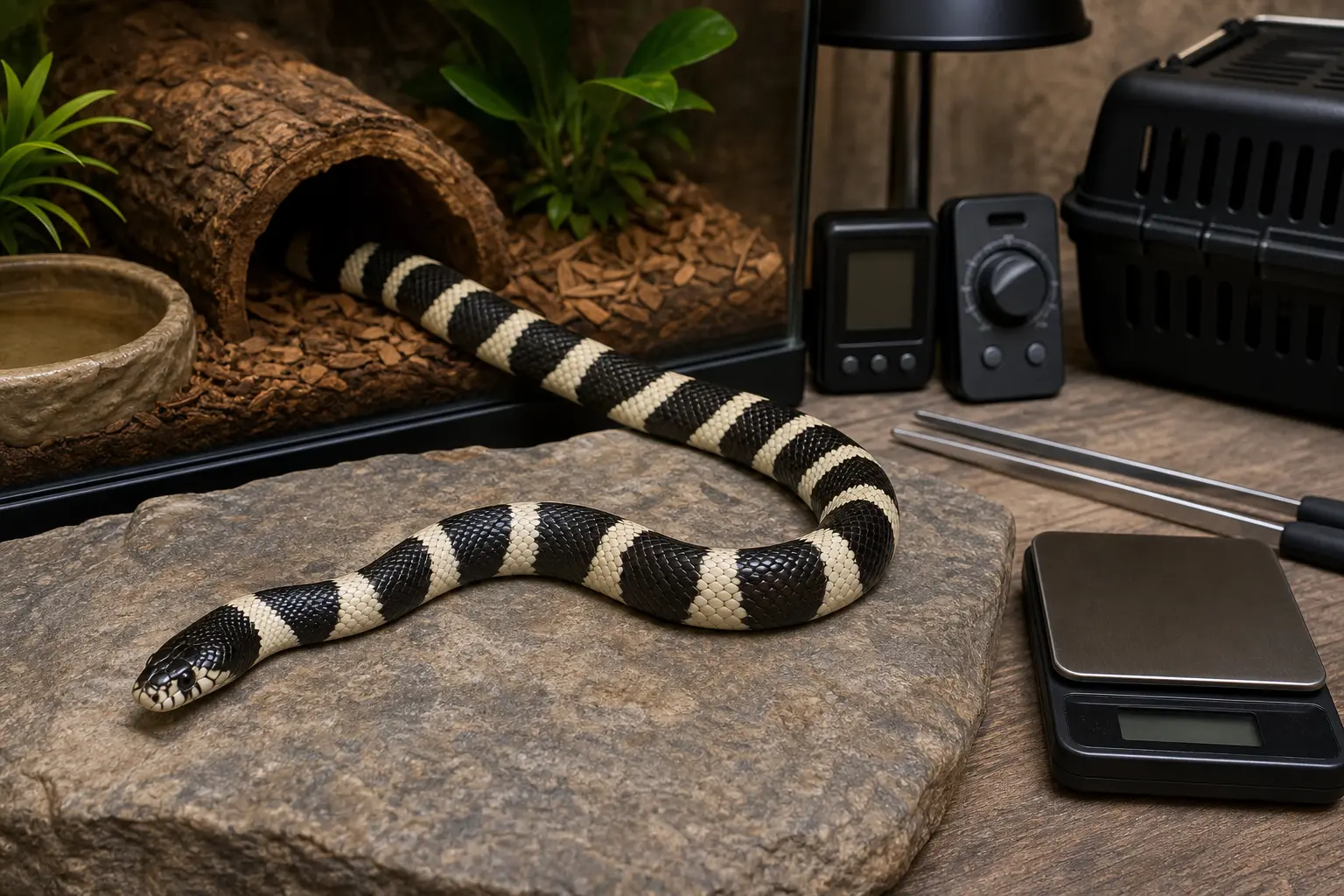
Adult California kingsnake with glossy black-and-cream bands and a clear eye in a finished habitat beside organized climate controls, lighting, care tools, a scale, and a carrier.

The short answer

Spend first on the home, controls, and backup plan for kingsnakes

Kingsnake care begins with a tested adult habitat. The checklist below covers what you need to measure, maintain, and transport safely.

Adult home
For the California kingsnake reference, at least 120 × 60 × 60 cm (48 × 24 × 24 in), securely locked
Warm zone
Basking surface around 30–32°C (86–90°F)
Cool and night
Cool covered end around 22–25°C (72–77°F); All visible lights off; use controlled non-light heat only if the room falls below the reviewed safe range
Humidity
About 40–60%, with fresh water, ventilation, dry footing, and a clean humid retreat during shed
UVB
Low-output linear UVB measured around UVI 1.0 at basking level, grading to zero in shade
Food
Appropriately sized fully thawed whole rodents offered with long tongs; house kingsnakes separately

The honest fit

Would the adult routine work in your home?

Do this

  • Buy and test the adult enclosure before adoption.
  • Keep backup batteries, replacement dates, a carrier, and vet details.
  • Keep fresh water and monitor kingsnake behavior every day.
  • Record changes so a reptile veterinarian receives useful evidence.

Avoid this

  • Do not rely on an undersized all-in-one starter kit.
  • Do not spend the safety budget on decorative extras first.
  • Do not copy another reptile species' setup.
  • Do not treat a persistent health change as a shopping problem.
01

Build the adult home first

Start with the species adult minimum shown above. Add secure doors, ventilation, stable cover, and usable routes before choosing decorative plants or substrate.

The enclosure should be fully assembled and running before adoption. That week of testing reveals weak locks, unstable branches, unreachable cleaning areas, and climate equipment that cannot hold the target range.

Adult California kingsnake moving across chaparral rock with its complete black-and-cream banded body and small glossy head in clear view.
02

Measure every life-support system

Use the correct thermostat for each heater, separate warm and cool thermometers, a hygrometer, plug timers, guarded heat, and measured low-output UVB.

Keep spare batteries and the lamp's replacement date with your records. A handheld infrared thermometer can help spot-check surfaces, but it does not replace fixed air-temperature probes.

Alert adult California kingsnake exploring a secure naturalistic enclosure with its glossy black-and-cream banded body and small clear-eyed head in view.
03

Prepare food, cleaning, and transport

Set aside species-appropriate food tools, supplement storage, a gram scale, reptile-safe disinfectant, paper towel, a secure ventilated carrier, and the reptile veterinarian's contact details.

Keep reptile bowls, tongs, cloths, and waste equipment separate from human kitchen items. A complete setup includes money and a plan for replacement lamps, failed controls, veterinary visits, and safe transport.

Keep deciding

See the complete care picture

Sources and further reading