

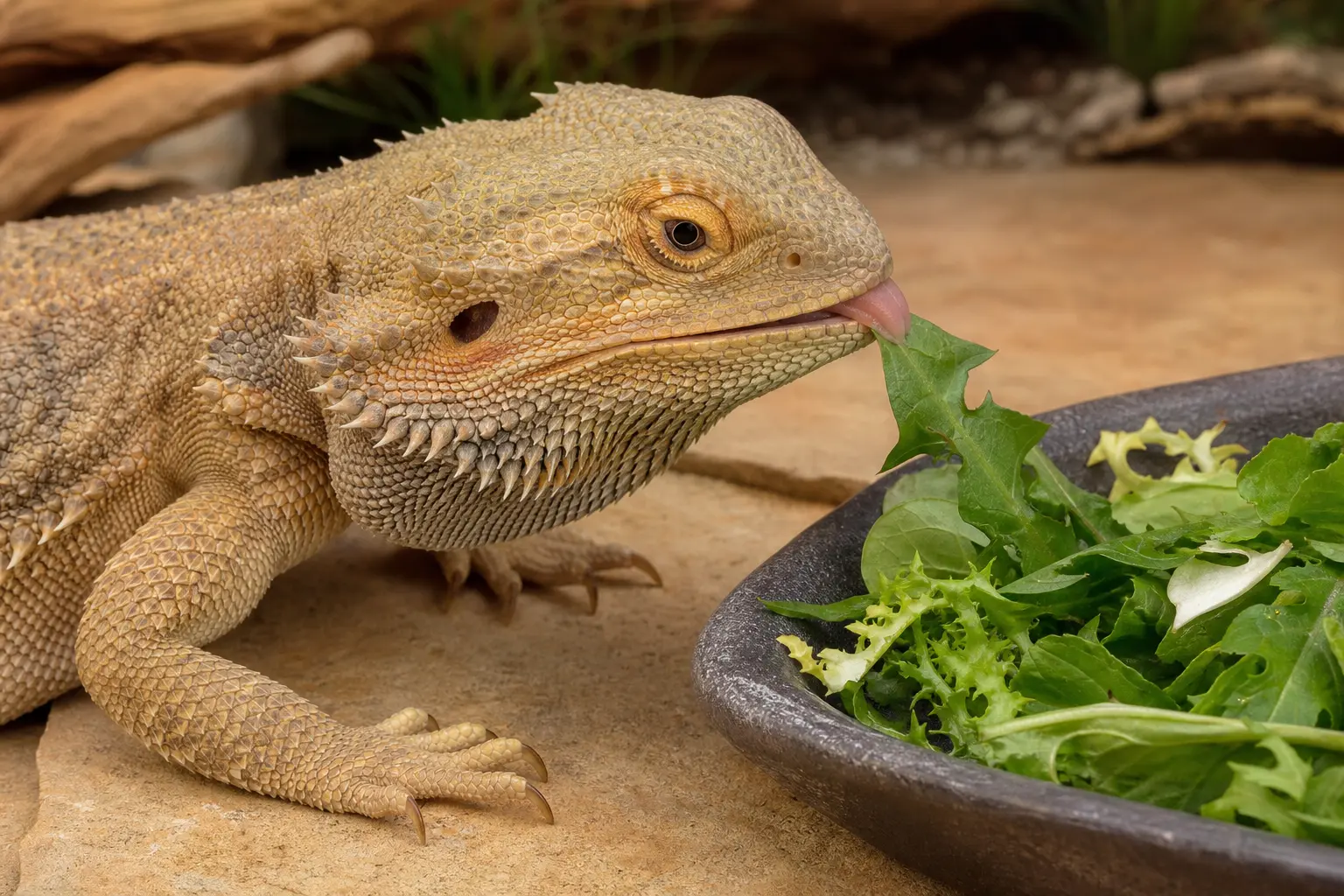
Bearded dragon · Feeding rhythm

How often should I feed a bearded dragon?

Set the bearded dragon schedule from the species and age guidance below. Use regular weigh-ins and veterinary advice to adjust it for the individual.

A predictable evening routine makes actual intake, leftovers, and changes in appetite easier to notice.

Use the practical checks
Adult bearded dragon beside a measured morning meal, feeding tools, a gram scale, and a closed care notebook.

The short answer

Set a repeatable schedule and verify the weight trend for bearded dragons

Set the bearded dragon schedule from the species and age guidance below. Use regular weigh-ins and veterinary advice to adjust it for the individual.

Adult home
At least 120 × 60 × 60 cm (48 × 24 × 24 in) for one adult; larger usable floor space is welcome
Warm zone
RSPCA bright-end basking zone 38–42°C (100–108°F); RVC guidance 35–40°C (95–104°F)
Cool and night
Cool shaded end 22–26°C (72–79°F); All lights off; controlled non-light heat if needed to stay at least 20–22°C (68–72°F)
Humidity
Low ambient humidity around 30–40%, measured with a hygrometer and supported by good ventilation
UVB
High-output linear UVB with a measured UVI gradient of 3.0–5.0 at the basking zone down to zero in shade
Food
An age-adjusted mix of varied safe greens and gut-loaded, supplemented captive-bred invertebrates

The honest fit

Would the adult routine work in your home?

Do this

  • Match the schedule to age and body condition.
  • Track weight and actual intake instead of guessing from appetite.
  • Keep fresh water and monitor bearded dragon behavior every day.
  • Record changes so a reptile veterinarian receives useful evidence.

Avoid this

  • Do not force-feed a dragon because it skipped one meal.
  • Do not ignore weight loss while repeatedly changing foods.
  • Do not copy another reptile species' setup.
  • Do not treat a persistent health change as a shopping problem.
01

Match the life stage

The practical starting point is: rSPCA guidance: babies twice daily, juveniles and adults once daily; shift toward roughly 60% greens after 30 cm while tracking body condition. Growing, breeding, recovering, underweight, or overweight dragons need an individualized plan rather than an adult maintenance schedule copied unchanged.

Offer food when the species is becoming active, note what was actually eaten, and remove spoilable food or uneaten insects promptly. Fresh water remains available every day regardless of feeding night.

Adult central bearded dragon climbing onto broad cork with its bright eye, natural beard, sturdy legs, and long tail clearly visible.
02

Judge more than an empty dish

Weigh the dragon on the same gram scale at a consistent interval and watch body condition, tail or hip contours, stool, and activity. One enthusiastic meal does not prove that the long-term amount is right.

Treats and fatty feeders can distort appetite and condition. Keep them occasional, maintain variety where appropriate, and do not respond to weight gain by withholding balanced nutrition without veterinary input.

Adult central bearded dragon crossing a bright basking ledge toward a shaded stone retreat.
03

Change the plan for a reason

Review heat, UVB, humidity, stress, and food freshness before assuming a skipped meal is preference. Reptiles cannot process food normally when their environmental conditions are wrong.

Persistent refusal with weight loss, weakness, swelling, abnormal droppings, or a distended abdomen deserves a reptile-veterinary call. Do not force-feed unless a veterinarian directs the method and timing.

Keep deciding

See the complete care picture

Sources and further reading