Box turtle · Feeding rhythm

How often should I feed a box turtle?

Set the box turtle schedule from the species and age guidance below. Use regular weigh-ins and veterinary advice to adjust it for the individual.

A predictable evening routine makes actual intake, leftovers, and changes in appetite easier to notice.

Use the practical checks
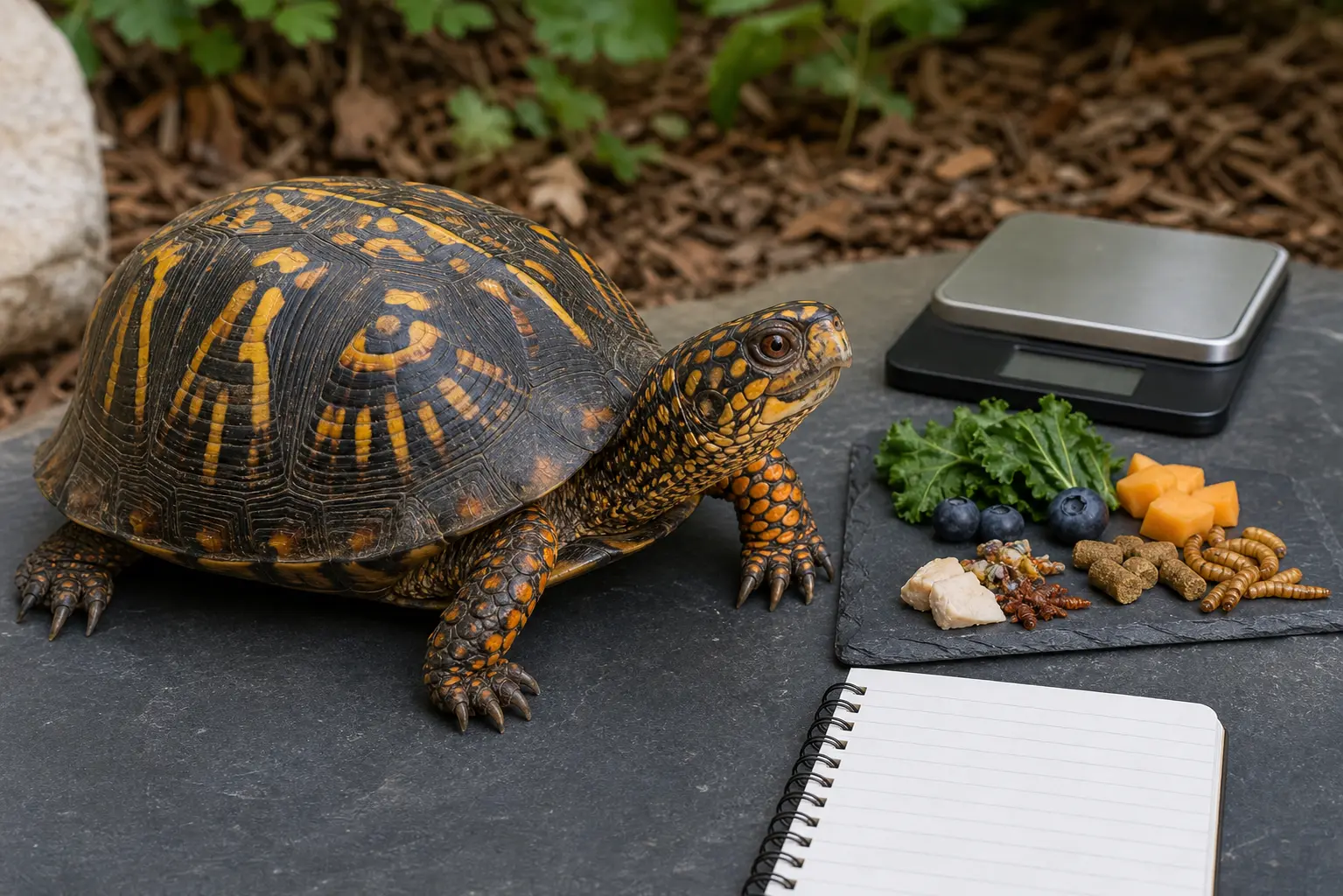
Adult common box turtle with a dark yellow-orange patterned shell and sturdy legs beside a measured meal, a gram scale, clean feeding tools, and a closed care notebook.

The short answer

Set a repeatable schedule and verify the weight trend for box turtles

Set the box turtle schedule from the species and age guidance below. Use regular weigh-ins and veterinary advice to adjust it for the individual.

Adult home
At least 240 × 120 cm (8 × 4 ft) for one adult; exact climate and layout must match the identified Terrapene species
Warm zone
Broad ground-level basking patch around 32–35°C (90–95°F)
Cool and night
Deep planted shade around 21–25°C (70–77°F); All visible lights off; seasonal cooling or brumation only under an exact-species and veterinary plan
Humidity
Species-dependent, usually with deep humid soil, generous leaf litter, airflow, and a shallow clean soaking area
UVB
Measured moderate UVB over basking ground, grading into complete leafy shade
Food
A varied omnivorous menu of reputable invertebrates, leafy plants, vegetables, fungi, and limited fruit matched to species and age

The honest fit

Would the adult routine work in your home?

Do this

  • Match the schedule to age and body condition.
  • Track weight and actual intake instead of guessing from appetite.
  • Keep fresh water and monitor box turtle behavior every day.
  • Record changes so a reptile veterinarian receives useful evidence.

Avoid this

  • Do not force-feed a turtle because it skipped one meal.
  • Do not ignore weight loss while repeatedly changing foods.
  • Do not copy another reptile species' setup.
  • Do not treat a persistent health change as a shopping problem.
01

Match the life stage

The practical starting point is: young turtles usually eat more often than adults; set frequency from exact species, age, season, weight, activity, and veterinary guidance. Growing, breeding, recovering, underweight, or overweight turtles need an individualized plan rather than an adult maintenance schedule copied unchanged.

Offer food when the species is becoming active, note what was actually eaten, and remove spoilable food or wilted food and rejected prey promptly. Fresh water remains available every day regardless of feeding night.

Representative adult common box turtle on woodland leaf litter with its complete high-domed dark shell, warm yellow-orange markings, patterned head, and legs in view.
02

Judge more than an empty dish

Weigh the turtle on the same gram scale at a consistent interval and watch body condition, tail or hip contours, stool, and activity. One enthusiastic meal does not prove that the long-term amount is right.

Treats and fatty feeders can distort appetite and condition. Keep them occasional, maintain variety where appropriate, and do not respond to weight gain by withholding balanced nutrition without veterinary input.

Alert adult common box turtle exploring deep woodland leaf litter with its high-domed dark shell, warm yellow-orange markings, patterned head, and sturdy legs in view.
03

Change the plan for a reason

Review heat, UVB, humidity, stress, and food freshness before assuming a skipped meal is preference. Reptiles cannot process food normally when their environmental conditions are wrong.

Persistent refusal with weight loss, weakness, swelling, abnormal droppings, or a distended abdomen deserves a reptile-veterinary call. Do not force-feed unless a veterinarian directs the method and timing.

Sources and further reading

Useful tools for this feeding routine

Three optional picks matched to this species' feeding style. Confirm foods and supplements in the exact care plan before buying.

Affiliate links: Furball Cove may earn from qualifying purchases at no extra cost to you.
Clear airtight dry-food containers with locking lids on a dedicated shelf.

Airtight dry-food container

Keep dry diets sealed, labeled, and separate from human food storage.

Check current options
Heavy low-profile ceramic food dish on a clean feeding surface.

Heavy ceramic food dish

A stable, washable dish keeps a species-appropriate meal off loose substrate.

Check current options
Unbranded pet-safe cleaning spray beside a clean reusable cloth.

Reptile habitat disinfectant

Choose a reptile-labeled cleaner and follow its dilution, contact-time, and rinse directions.

Check current options