Painted turtle · Feeding rhythm

How often should I feed a painted turtle?

RSPCA guidance starts at feeding a painted turtle every two days, offering only what it eats in about five minutes. Adjust for age, growth, body condition, and the complete menu.

Sliders are opportunistic feeders, so enthusiasm at the glass is not a reliable portion guide.

Use the practical checks
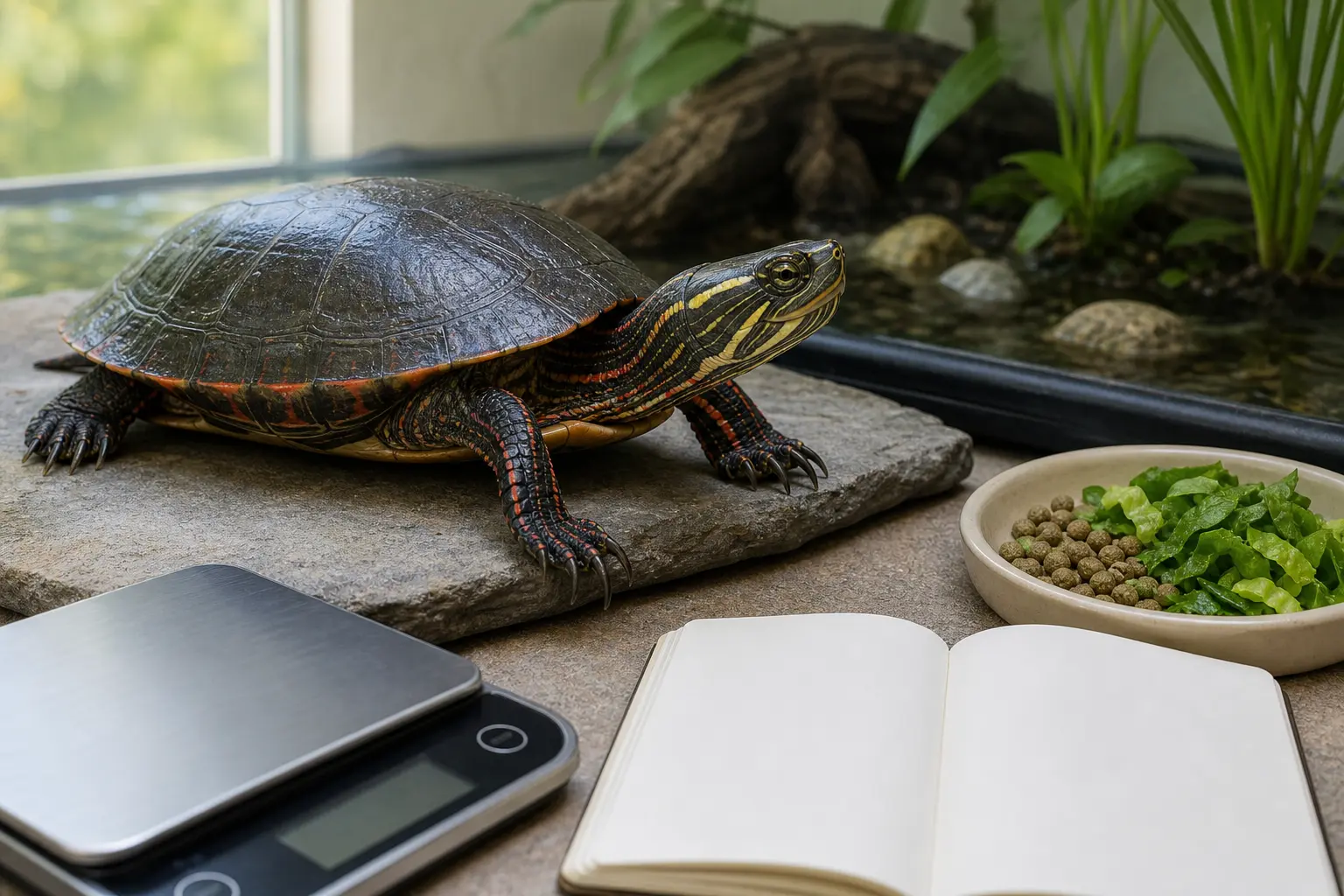
Adult painted turtle with a smooth dark shell, red-orange edges, and striped head beside a measured meal, a gram scale, clean feeding tools, and a closed care notebook.

The short answer

Time the meal, remove leftovers, and verify growth for painted turtles

RSPCA guidance starts at feeding a painted turtle every two days, offering only what it eats in about five minutes. Adjust for age, growth, body condition, and the complete menu.

Adult home
At least 300–450 L (80–120 US gal) for one adult, sized to the individual, with deep open water and a fully dry dock
Warm zone
Completely dry shell-sized basking platform around 32–35°C (90–95°F)
Cool and night
Clean filtered water around 23–26°C (73–79°F), adjusted for age and season; All visible lights off; maintain safe water temperature with guarded controlled equipment
Humidity
Clean tested water plus open ventilation above the tank so the shell dries completely while basking
UVB
Measured moderate UVB across the whole dry dock, with aquatic shade and product-specific distance guidance
Food
Quality aquatic-turtle pellets, safe aquatic and leafy plants, and varied appropriate invertebrate or whole animal foods

The honest fit

Would the adult routine work in your home?

Do this

  • Match the schedule to age and body condition.
  • Track weight and actual intake instead of guessing from appetite.
  • Keep fresh water and monitor painted turtle behavior every day.
  • Record changes so a reptile veterinarian receives useful evidence.
Avoid this

  • Do not force-feed a turtle because it skipped one meal.
  • Do not ignore weight loss while repeatedly changing foods.
  • Do not copy another reptile species' setup.
  • Do not treat a persistent health change as a shopping problem.
01

Start with a bounded meal

Juveniles eat more often than adults; adjust meal size and schedule from age, shell length, weight, body condition, and veterinary advice. Prepare the portion before opening the aquarium and stop the meal rather than repeatedly topping it up.

Remove leftovers with a net so they do not decay into ammonia. Keep safe edible plants available according to the reviewed diet plan and refresh them before they foul the water.

Adult painted turtle basking above a pond with its complete smooth dark shell, vivid red-orange shell margins and legs, striped head, and long claws in view.
02

Let age change the balance

Young sliders typically need a greater animal-food share while adults shift toward more plant matter. Record meal composition, not only feeding dates.

Weigh the turtle on the same scale and watch shell growth and body condition. Overfeeding can promote obesity, rapid growth, and worsening water quality. Ask your veterinarian to assess body condition before making a major restriction.

Alert adult painted turtle basking fully dry above clean deep water with its smooth dark shell, red-orange margins and legs, and striped head in view.
03

Investigate appetite changes

Review water and basking temperatures, UVB, water quality, stress, seasonal changes, and food freshness before assuming refusal is preference.

Call a reptile veterinarian for continuing refusal with weight loss, swollen eyes, breathing changes, abnormal swimming, soft shell, mouth changes, diarrhea, or weakness. Do not force-feed without direction.

Sources and further reading

Useful tools for this feeding routine

Three optional picks matched to this species' feeding style. Confirm foods and supplements in the exact care plan before buying.

Affiliate links: Furball Cove may earn from qualifying purchases at no extra cost to you.

Aquatic turtle diet pellets in a measured feeding scoop beside a water-safe dish.

Aquatic turtle diet pellets

Start with a reputable pellet made for the exact aquatic turtle and life stage.

Check current options
Clear airtight dry-food containers with locking lids on a dedicated shelf.

Airtight dry-food container

Keep dry diets sealed, labeled, and separate from human food storage.

Check current options
Compact digital gram scale with a removable tray beside a small ceramic reptile food dish.

Digital gram scale with tray

Measure small portions and monitor a feeding plan without guessing by eye.

Check current options