

Blue-tongued skink · UVB and shade

Does a blue-tongued skink need UVB?

Blue-tongued skink care should include the measured species-appropriate linear UVB gradient below. Preserve complete shade and switch every light off at night.

The amount reaching the skink changes with its distance from the lamp and anything positioned between them.

Use the practical checks
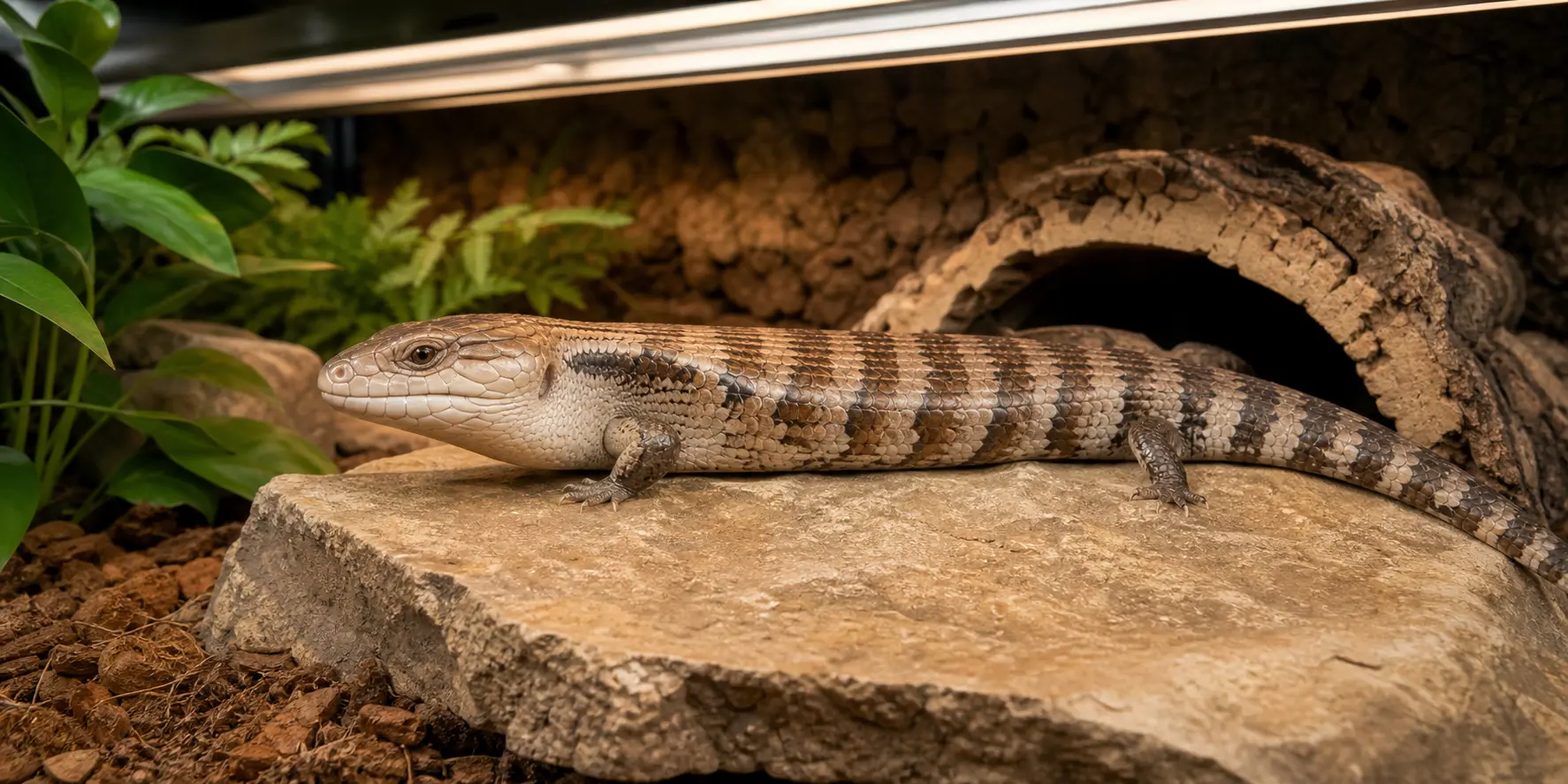
Adult eastern blue-tongued skink using a broad basking platform beneath linear UVB with deep shade immediately available.

The short answer

Offer gentle UVB with an immediate route to shade for blue-tongued skinks

Blue-tongued skink care should include the measured species-appropriate linear UVB gradient below. Preserve complete shade and switch every light off at night.

Adult home
At least 120 × 75 × 75 cm (48 × 30 × 30 in) for one adult, with broad usable floor space
Warm zone
Adult basking zone about 30–32°C (86–90°F)
Cool and night
Cool end about 22–25°C (72–77°F); All visible lights off; any needed non-light heat remains thermostat controlled
Humidity
Match the confirmed species and locality; use a cool-end hygrometer and provide a clean measured moist hide
UVB
A measured UVI gradient of 3.0–5.0 at the basking zone down to zero in shade
Food
A varied omnivorous diet with both safe plant foods and appropriately prepared animal matter

The honest fit

Would the adult routine work in your home?

Do this

  • Measure exposure where the skink can actually sit.
  • Provide an immediate route from light into complete shade.
  • Keep fresh water and monitor blue-tongued skink behavior every day.
  • Record changes so a reptile veterinarian receives useful evidence.

Avoid this

  • Do not choose a lamp by percentage without distance guidance.
  • Do not leave visible lighting on overnight.
  • Do not copy another reptile species' setup.
  • Do not treat a persistent health change as a shopping problem.
01

Design light and shade together

For a blue-tongued skink, use a measured UVI gradient of 3.0–5.0 at the basking zone down to zero in shade. Group the brighter zone with daytime warmth while preserving dark retreats and foliage or hide cover nearby.

A lamp percentage cannot predict the dose on its own. Follow the fixture maker's distance chart, account for mesh, and measure at the highest place the skink can actually reach when possible.

Adult eastern blue-tongued skink exploring pale stone with its broad banded body, clear eye, small sturdy limbs, and blue tongue in close view.
02

Keep the cycle predictable

Run the daytime lighting on a timer for roughly 12 hours, then make the enclosure dark overnight. Replace the lamp on schedule or verify output with an appropriate meter.

Secure or guard fixtures so the skink cannot contact hot glass or a breakable lamp. After rearranging climbing routes or hides, re-check distance and shade instead of assuming the old setup still applies.

Alert adult eastern blue-tongued skink exploring a broad naturalistic habitat with its sturdy banded body, clear eye, and vivid blue tongue in view.
03

Coordinate food and UVB

UVB, heat, calcium, and the rest of the diet work as one husbandry system. More supplement is not a safe substitute for unmeasured lighting, and more UVB is not automatically better.

Discuss supplement choice with a reptile veterinarian, especially for a albino or unusually light-sensitive morph, a growing juvenile, an egg-producing female, or a skink showing weakness or skeletal change.

Keep deciding

See the complete care picture

Sources and further reading