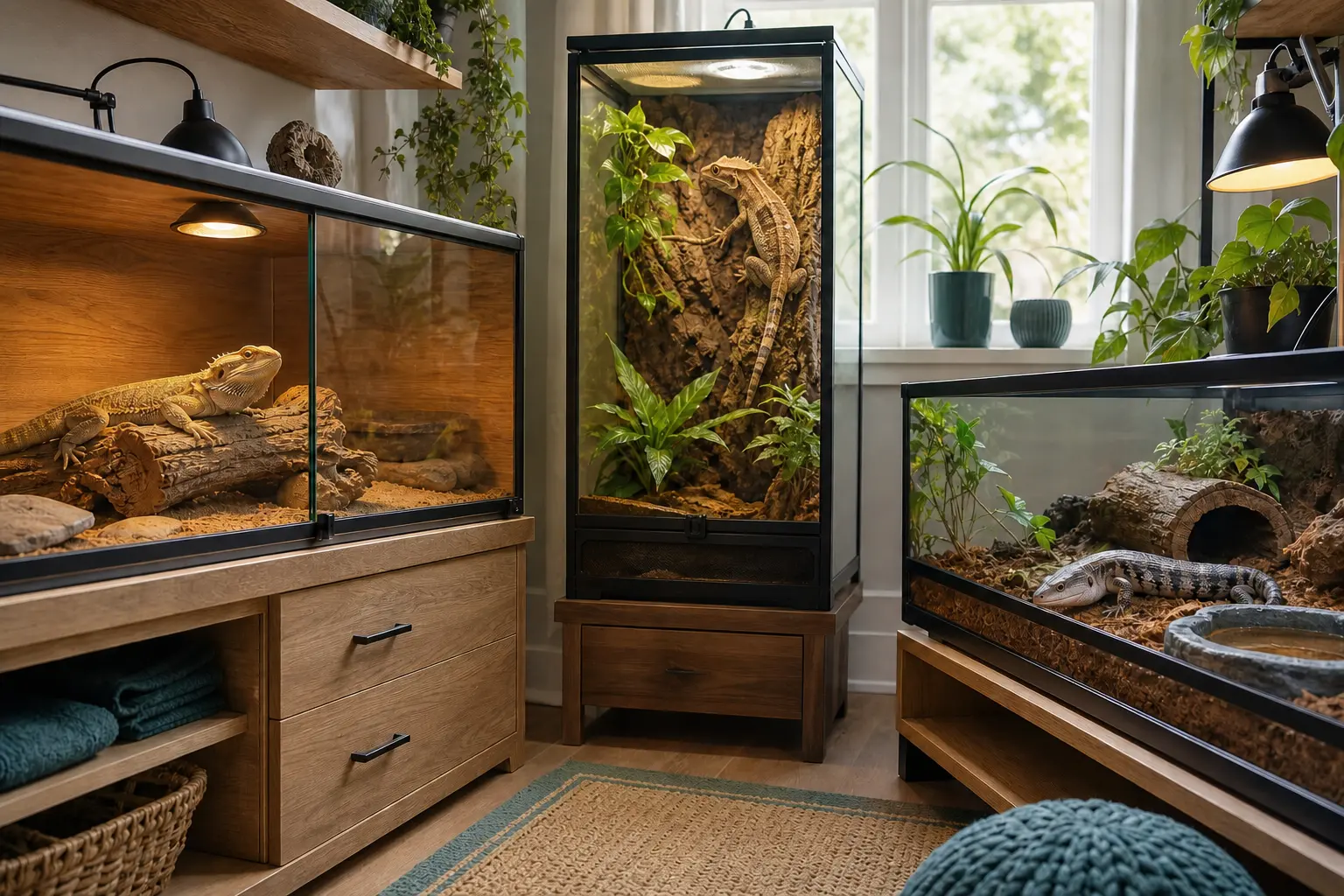
Daytime hiding is normal; evening is when the enclosure becomes interesting
Tokay gecko · Gekko gecko
The Tokay gecko has something to say.
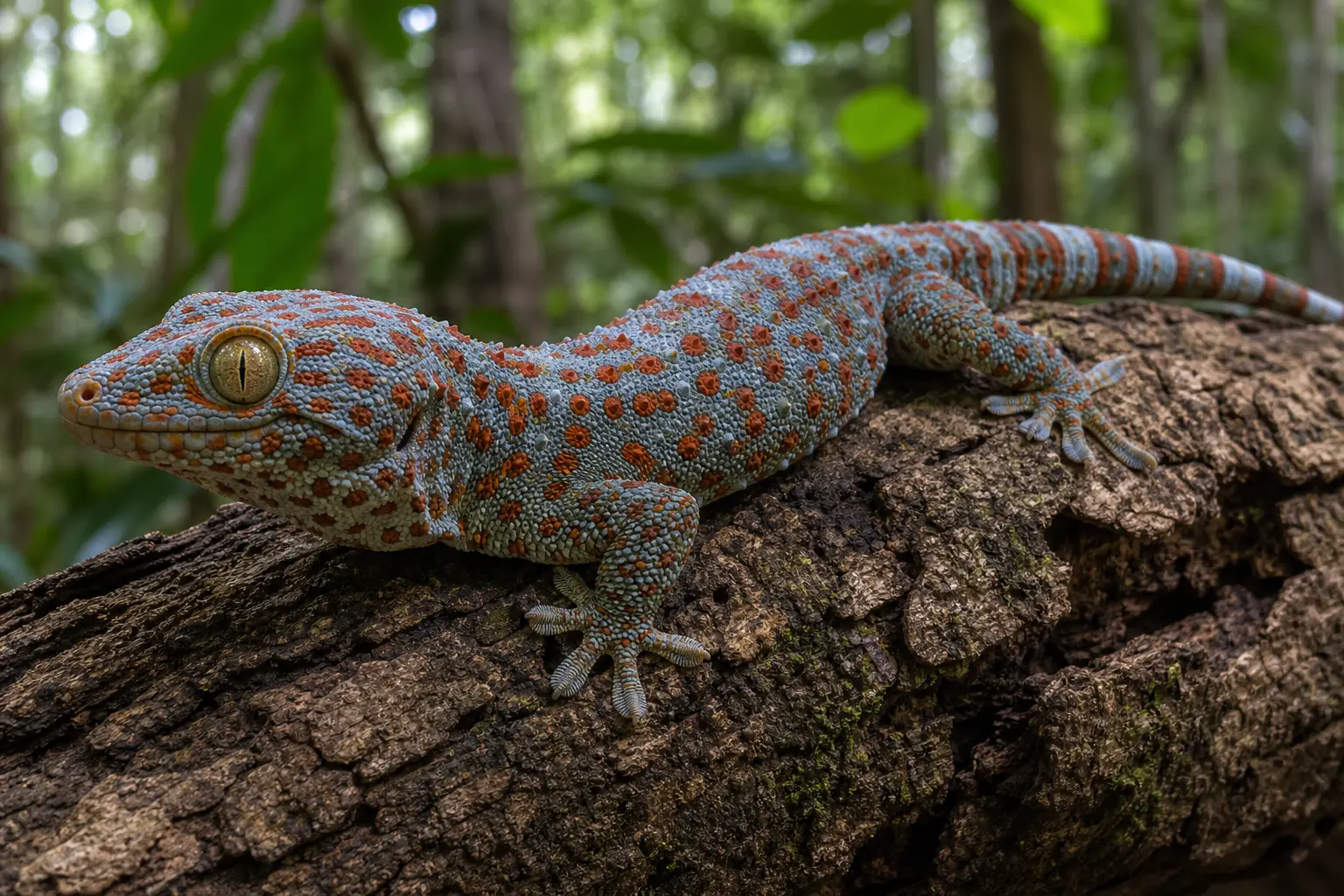
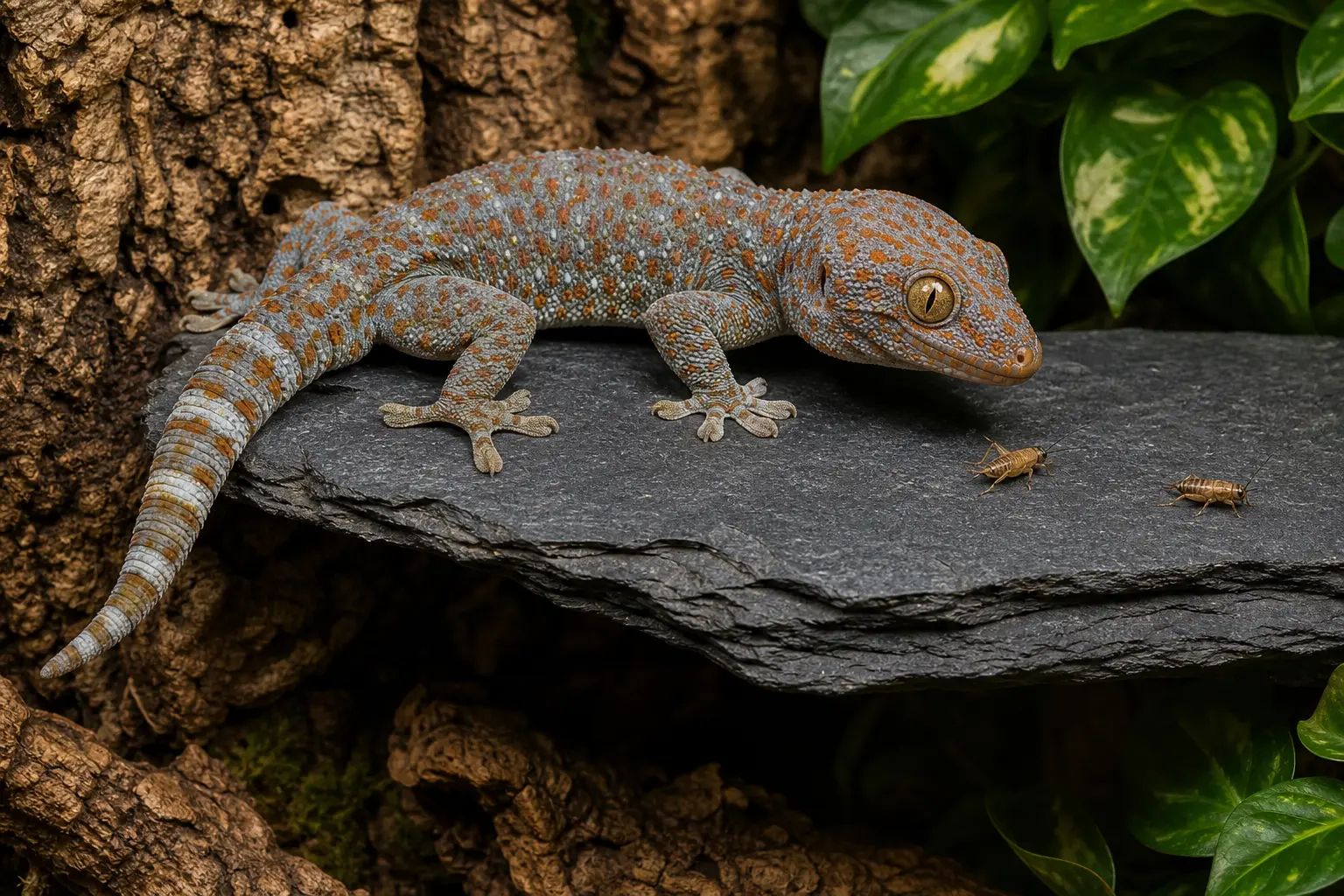
Blue-grey scales, ember-bright spots, golden eyes, and a voice that can fill the night.
This is a large, watchful gecko with powerful feet and firm boundaries.
Get to know them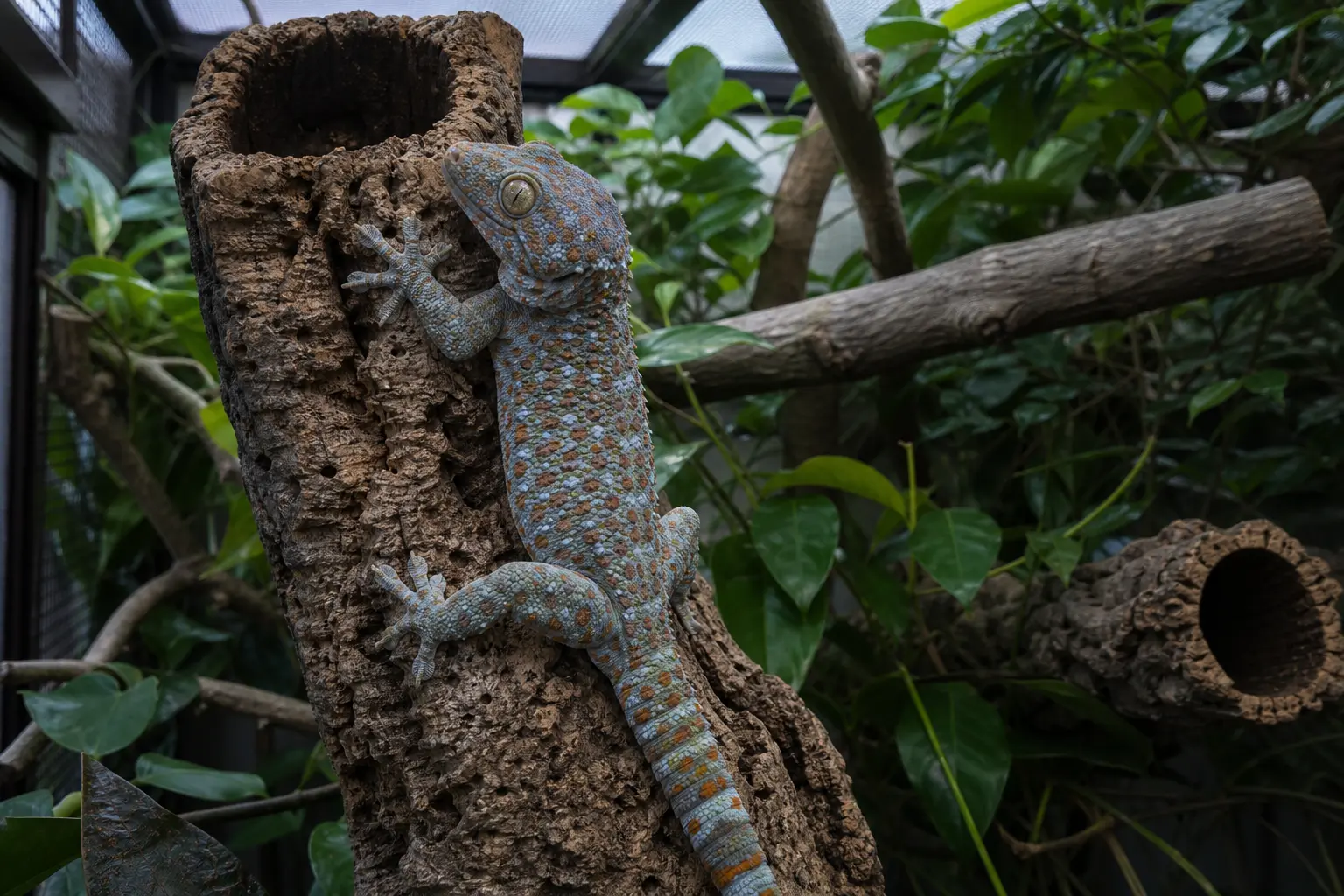
Personality and daily life
A quiet silhouette—until the forest wakes.
During the day, a Tokay can vanish against bark. After dark, broad toes carry that blue-and-orange body across glass, cork, and branches while enormous eyes follow every movement. Then comes the call: loud, rhythmic, and entirely their own.
Beautiful to some households, disruptive to others—especially near a bedroom
A big male can approach 40 cm, though many adults are closer to 25–30 cm
Retreating, gaping, calling, or lunging means give space—not try harder
What to expect
Could you love a gecko you rarely touch?
Tokays suit people who find closeness in watching. Their life asks for a large vertical home, varied live insects, warm humid nights, quiet daytime privacy, and care routines that do not depend on handling.
The honest fit
Would you enjoy life together?
A good match wants the Tokay exactly as it is: nocturnal, vocal, insect-eating, private, and spectacular without being handled.
You may be a lovely match if…
- You enjoy evening observation and can leave a hidden gecko undisturbed
- A large, secure vertical enclosure can have a permanent place in your home
- Keeping varied live insects and measuring a tropical climate feels manageable
- You can work calmly around speed, firm boundaries, and a possible defensive bite
Think twice if…
- You want a reptile for regular handling, cuddling, or daytime companionship
- A loud nighttime call would be unwelcome where you live
- Door-open feeding and cleaning would feel frightening or hard to secure
- You cannot verify captive-bred origin or reach a reptile veterinarian
A comfortable home
Build a canopy with somewhere to disappear.
Height alone is not enough. Give a Tokay thick connected branches, cork hollows, sturdy ledges, deep leaves, shade, clean water, and more than one route between warmer and cooler cover. The doors should make everyday care calm and escape-resistant.
An adult over 30 cm needs at least 90 cm of length as well
A current guide uses 32–38°C on the upper surface and 26–29°C in the cooler zone; exact setup needs review
Work within a measured 60–80% cycle, with fresh air and daytime dry-down
A current guide suggests UVI 1–2; full shade must remain easy to reach
Feeding them well
Make room in your life for live insects.
Tokays are insect-focused hunters. A good routine means more than dropping crickets through a door: keep a varied feeder supply well, choose a safe size, prepare it thoughtfully, offer it cleanly, and remove what the gecko leaves behind.
Use safely sourced, appropriately sized feeders rather than one insect forever
Maintenance, gut-loading, clean offering, and removing leftovers all belong in the week
Feeder variety, UVB, age, body condition, and product directions change the answer
The rhythm
Keep the day quiet. Let the night belong to them.
Protect the hiding place
Refresh water, check locks and readings, and clear waste without dismantling the retreat around a sleeping gecko.
Prepare for the hunter
Follow the misting plan, offer prepared live insects, and notice which routes, temperatures, and cover the Tokay chooses.
Leave the dark complete
Turn every visible light off. Listen, observe quietly, and make a note if appetite, grip, movement, or behaviour looks different.
Care with tenderness
Respect is the beginning of trust.
Do not make handling the goal
Some captive-bred Tokays learn predictable care routines. That does not make touch a requirement or a measure of success.
Never grab
Chasing, pinning, or seizing a Tokay can cause escape, tail injury, and a serious defensive bite. Plan safe transfers before they are needed.
One gecko, one home
Territorial natural history does not become companionship in glass. Give each adult a complete enclosure.
Keep care clean
Wash hands after the gecko, insects, food, waste, water, or equipment. Keep every reptile item out of kitchens.
Know their origin
Choose documented captive-bred animals or a reputable rescue. Tokays are CITES Appendix II listed, and wild-caught trade carries welfare and conservation concerns.
Good to know
Common questions, answered.
Open any question for a short, practical answer.
Life with a Tokay
What is a Tokay gecko?
Gekko gecko is a large nocturnal climbing gecko native to south and southeast Asia. Blue-grey skin, orange or red spots, broad adhesive toes, enormous lidless eyes, and the repeated call behind its common name make it instantly recognizable.
How big do Tokay geckos get?
Many adults are about 25–30 cm (10–12 in) long. Large males can approach 40 cm (16 in). Build around the adult in front of you, not the smallest number on a care sheet.
How long do Tokay geckos live?
Plan for 10–20 years. Smithsonian describes about 10 years in human care, while ReptiFiles cites up to 15–20. A long-term home and backup keeper are sensible whichever individual arrives.
Why are Tokay geckos so loud?
Vocal communication is part of Tokay life, and the repeated to-kay call gave the species its name. Frequency varies, but the possibility of a loud nighttime voice belongs in the household decision before adoption.
Are Tokay geckos good first reptiles?
They are better treated as a specialist choice. The enclosure and feeding can be learned, but a keeper must also be calm around speed, escape risk, live prey, nighttime noise, firm boundaries, and a defensive bite.
Can Tokay geckos be handled?
Do not choose one for handling. Some captive-bred individuals learn calm, hands-off care routines and may voluntarily approach, while others remain defensive. Never grab, chase, or press for contact.
What happens if a Tokay bites?
A Tokay can bite hard and hold on. Prevention is the page's useful answer: respect warnings, avoid grabbing, keep access secure, and learn a safe transfer plan from an experienced reptile professional or veterinarian before an emergency.
Can two Tokay geckos live together?
Plan one adult per enclosure. Tokays are territorial, and sharing a home is not companionship. A breeding project is separate, advanced work with spare housing and expert oversight.
What enclosure does one adult need?
Start from 60 × 60 × 120 cm (24 × 24 × 48 in) for one adult. If the gecko is longer than 30 cm, use at least 90 × 60 × 120 cm (36 × 24 × 48 in). Fill that space with sturdy connected routes and deep cover.
Home, food, and health
What temperatures does a Tokay gecko need?
A current care guide uses a 32–38°C (90–100°F) upper basking surface, 26–29°C (80–85°F) cooler zone, and 24–26°C (76–80°F) at night. These are bounded review targets: measure several heights, guard and control heat appropriately, and preserve easy cooler escape.
How should humidity work?
Aim for movement, not one frozen number. A current guide uses roughly 60–80%, usually rising after evening misting and falling through the day. Keep ventilation open and let surfaces dry rather than maintaining constant wetness.
Does a Tokay gecko need UVB?
A current guide recommends measured UVI 1–2, while general veterinary guidance is less prescriptive for nocturnal geckos. If you provide UVB, measure it at the gecko's back height, cover only part of the enclosure, and leave full shade.
What do Tokay geckos eat?
Use a varied rotation of appropriately sized, captive-reared live insects. Tokays are insect-focused hunters; vertebrate prey and prepared fruit diets are not needed as staples in this care plan.
How often should I feed one?
Age, size, body condition, appetite, feeder type, and the exact supplement plan all matter. Track weight and prey accepted, follow product directions, and set the calendar with a reptile veterinarian instead of copying one universal schedule.
Does a Tokay need a water bowl if I mist?
Yes. Keep clean fresh water available at all times in a stable accessible dish. Misting adds droplets and supports the humidity cycle, but it does not replace a reliable water source.
What substrate should I use?
Begin with a simple surface that makes food, waste, hydration, and sheds easy to monitor. A healthy established gecko may use a well-managed naturalistic substrate with leaf litter, provided it handles moisture without becoming waterlogged.
What should I do about stuck shed?
Do not pull it. Check fresh water, the humidity rise and dry-down, ventilation, textured routes, toes, eyes, and skin. Recurring trouble or changes in grip need a reptile veterinarian.
When should I call a reptile veterinarian?
Call for persistent changes in appetite, weight, droppings, activity, eyes, mouth, skin, shedding, tail, grip, movement, breathing, swelling, weakness, or injury. These are reasons to call, not a diagnosis.
Can a healthy Tokay gecko carry Salmonella?
Yes. Wash with soap and running water after the gecko, insects, food, waste, water, or equipment, and keep every supply out of kitchens. Higher-risk households need particular care.
What should be ready before one comes home?
Run the full adult enclosure first. Confirm sturdy routes, secure doors, a guarded warm branch, cooler cover, humidity dry-down, ventilation, shade, water, a feeding plan, a transfer plan, and a reptile-veterinary contact. Then verify documented captive-bred origin or reputable rescue history.
Build the night before the gecko arrives.
Test the adult home's doors, sturdy climbing routes, warm branch, cooler cover, humidity dry-down, ventilation, shade, water, and feeding access before bringing a Tokay home.
Plan heat, humidity, and lightSources and care boundaries
Exact targets depend on the measured location, equipment, animal, and veterinary context. This profile keeps source disagreements visible instead of blending them into one number.
- The Reptile Database: Gekko gecko
- Smithsonian's National Zoo and Conservation Biology Institute: Tokay gecko
- Amphibia-Reptilia: Foraging ecology of the Tokay gecko, Gekko gecko in a residential area in Thailand
- ReptiFiles: Tokay Gecko Care Sheet
- Convention on International Trade in Endangered Species: Gekko gecko (tokay gecko) – Inclusion in Appendix II
- MSD Veterinary Manual: Management and Husbandry of Reptiles
- MSD Veterinary Manual: Routine Health Care of Reptiles
- U.S. Centers for Disease Control and Prevention: Reptiles and Amphibians
- Association of Reptile and Amphibian Veterinarians: For Reptile and Amphibian Owners