Russian tortoise · Feeding rhythm

How often should I feed a Russian tortoise?

RSPCA guidance feeds young russian tortoises daily and older tortoises every other day. Adjust the amount from safe grazing access, body condition, season, and reptile-veterinary advice.

A plant eater can still gain excess weight or miss key nutrients. Record the menu as well as the calendar.

Use the practical checks
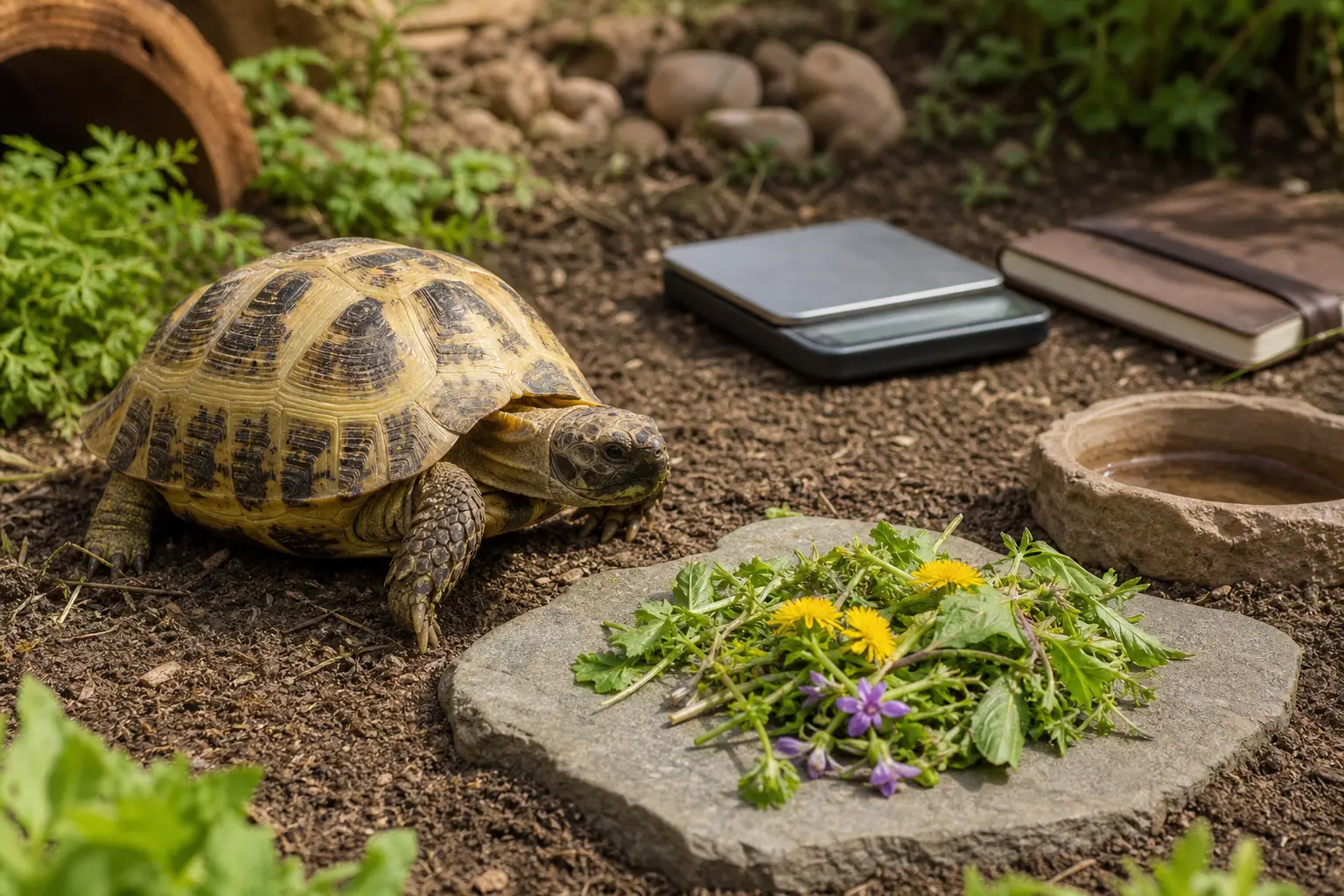
Adult Russian tortoise beside a measured daytime plant meal, a gram scale, and a closed care notebook in a bright naturalistic habitat.

The short answer

Start with life stage and verify steady condition for russian tortoises

RSPCA guidance feeds young russian tortoises daily and older tortoises every other day. Adjust the amount from safe grazing access, body condition, season, and reptile-veterinary advice.

Adult home
At least 180 × 120 cm (71 × 47 in) indoors for one adult, plus a secure seasonal outdoor area where climate permits
Warm zone
Broad basking zone about 35°C (95°F)
Cool and night
Daytime ambient gradient about 20–25°C (68–77°F); Visible lights off; RSPCA guidance allows a nighttime drop toward 15°C (59°F) for a healthy, appropriately managed animal
Humidity
Dry, well-ventilated main habitat with deep burrowable substrate, a sheltered retreat, shallow clean water, and no waterlogged ground
UVB
Broad species-appropriate linear UVB over the basking area, installed to the fixture maker's measured distance guidance with complete shade
Food
A varied high-fibre, low-protein menu of safe pesticide-free weeds, leaves, and flowers with a reviewed calcium plan

The honest fit

Would the adult routine work in your home?

Do this

  • Match the schedule to age and body condition.
  • Track weight and actual intake instead of guessing from appetite.
  • Keep fresh water and monitor russian tortoise behavior every day.
  • Record changes so a reptile veterinarian receives useful evidence.
Avoid this

  • Do not force-feed a tortoise because it skipped one meal.
  • Do not ignore weight loss while repeatedly changing foods.
  • Do not copy another reptile species' setup.
  • Do not treat a persistent health change as a shopping problem.
01

Start with age and access

The practical starting point is: rSPCA guidance: young tortoises daily and older tortoises every other day, adjusted from body condition, safe grazing access, season, and veterinary advice. A tortoise grazing safe plants in a large outdoor area has a different intake pattern from one receiving prepared portions indoors.

Offer a changing mix of correctly identified plants rather than repeating one favorite. Keep shallow clean water available every day regardless of feeding schedule.

Adult Russian tortoise walking across dry steppe soil with its rounded patterned shell, sturdy forelegs, and bright face in clear view.
02

Track growth without pushing it

Weigh the tortoise on the same scale at a consistent interval and record shell length, gait, appetite, feces, and urates with the trend.

Do not speed growth with extra protein or oversized portions. Ask a reptile veterinarian to assess body condition before major restriction, supplementation changes, or any seasonal fasting plan.

Alert adult Russian tortoise walking through a spacious dry planted habitat with its rounded tan-and-dark shell, sturdy digging legs, and clear eyes in view.
03

Treat seasonal plans cautiously

Review basking temperature, UVB, daily light cycle, stress, food safety, and health before treating appetite change as normal seasonality.

Do not improvise brumation or hibernation. The RSPCA advises a veterinary health and weight assessment plus experienced species-specific planning before cooling a tortoise without food.

Keep deciding

See the complete care picture

Sources and further reading