Uromastyx · Feeding rhythm

How often should I feed a uromastyx?

Juvenile uromastyx commonly receive fresh plant food daily, while adults often eat every one to three days. Adjust the amount and interval from exact species, age, weight, and body condition.

A herbivorous lizard still needs portion awareness. Record the menu, actual intake, and weight trend instead of feeding from enthusiasm alone.

Use the practical checks
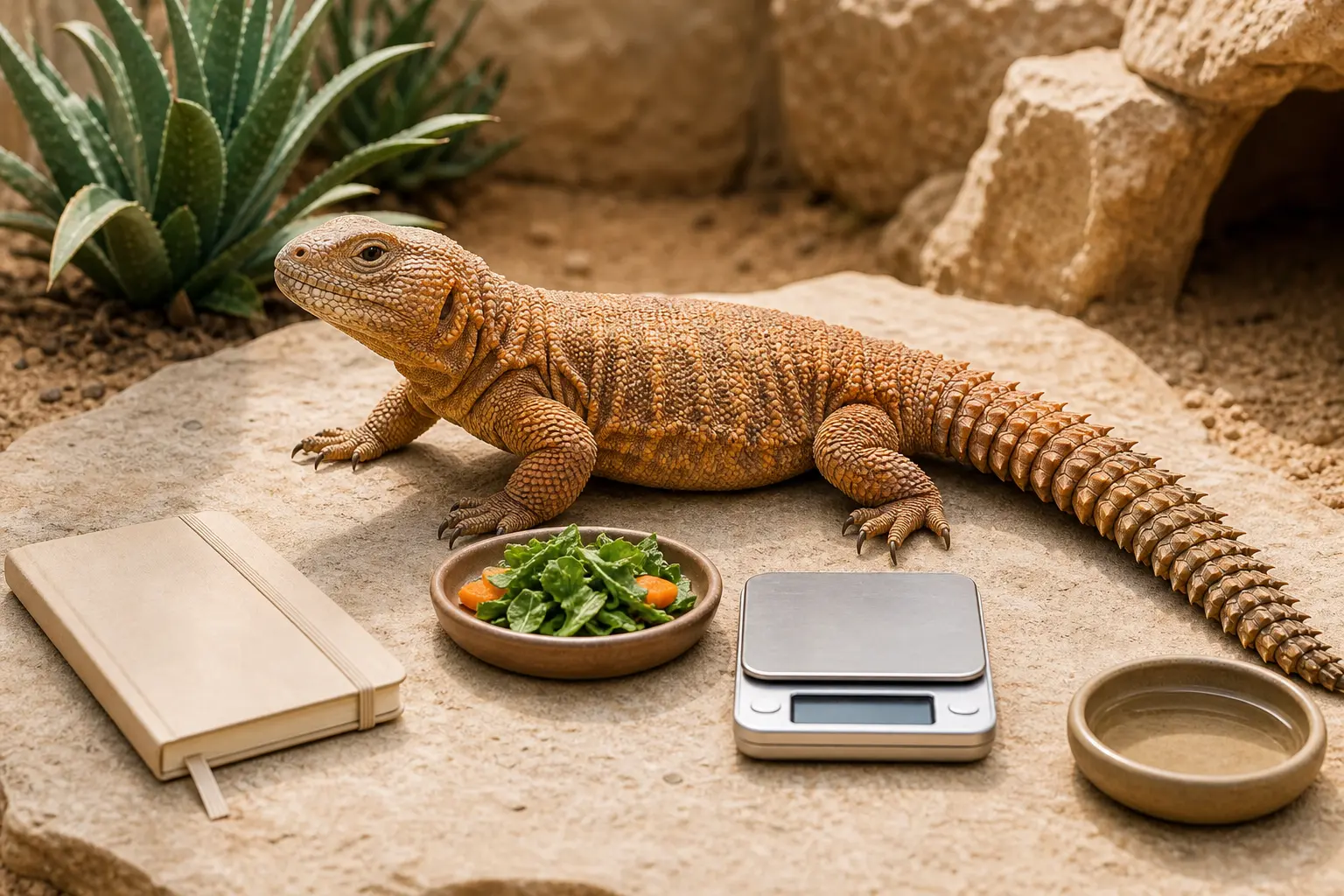
Adult Moroccan uromastyx beside a measured daytime plant meal, a gram scale, and a closed care notebook.

The short answer

Start with life stage and verify the body-condition trend for uromastyx

Juvenile uromastyx commonly receive fresh plant food daily, while adults often eat every one to three days. Adjust the amount and interval from exact species, age, weight, and body condition.

Adult home
Identify the exact species first; begin at 227 L (60 gal), then scale up substantially for longer species and provide broad floor space
Warm zone
Basking surface about 49°C (120°F); daytime gradient about 27–38°C (80–100°F)
Cool and night
A deep shaded retreat at the cool end; All visible lights off; allow a measured 5–8°C (10–15°F) drop
Humidity
Usually 10–40%, confirmed for the exact species, with dry ventilation, fresh water, and no persistently damp substrate
UVB
Strong measured linear UVB overlapping the broad basking zone, with unobstructed exposure and complete shade
Food
A varied herbivorous menu led by calcium-rich dark greens, grasses, leaves, and flowers, with suitable vegetables, pulses, and seeds in smaller roles

The honest fit

Would the adult routine work in your home?

Do this

  • Match the schedule to age and body condition.
  • Track weight and actual intake instead of guessing from appetite.
  • Keep fresh water and monitor uromastyx behavior every day.
  • Record changes so a reptile veterinarian receives useful evidence.

Avoid this

  • Do not force-feed a uromastyx because it skipped one meal.
  • Do not ignore weight loss while repeatedly changing foods.
  • Do not copy another reptile species' setup.
  • Do not treat a persistent health change as a shopping problem.
01

Use age as the starting point

The practical starting point is: juveniles commonly eat daily; adults every one to three days, adjusted from species, age, weight, and body condition. A growing animal, a large Egyptian uromastyx, and a smaller adult ornate uromastyx should not inherit identical portions from one calendar.

Offer fresh food during the bright active daytime period, note what is actually eaten, remove wilted leftovers, and keep fresh water available every day.

Adult Moroccan spiny-tailed lizard representing the pet uromastyx group, basking beside a rocky retreat with its sturdy body and complete whorled tail in clear view.
02

Weigh and look at shape

Use the same gram scale at a consistent interval and assess the tail base, hips, jaw, limbs, gait, activity, droppings, and urates with the trend.

Seeds, pulses, fruit, and calorie-dense vegetables can quietly crowd out leafy forage. Ask a reptile veterinarian to assess condition before aggressive restriction or major supplement changes.

Alert adult Moroccan uromastyx exploring a spacious dry rocky habitat with its broad head, sturdy orange-tan body, and complete armored spiny tail in view.
03

Investigate a change

Review basking surface, cool retreat, UVB, room season, humidity, food freshness, stress, and species identity before treating refusal as preference.

Persistent refusal with weight loss, weakness, swelling, abnormal stool or urates, breathing changes, or a distended abdomen deserves a reptile-veterinary call. Do not force-feed without direction.

Sources and further reading

Useful tools for this feeding routine

Three optional picks matched to this species' feeding style. Confirm foods and supplements in the exact care plan before buying.

Affiliate links: Furball Cove may earn from qualifying purchases at no extra cost to you.
Compact clear salad spinner filled with washed leafy greens.

Compact salad spinner

Wash and dry greens so leftovers are easier to spot and remove promptly.

Check current options
Plain reptile calcium powder in a small open supplement container with scoop.

Reptile calcium without D3

Use only when the exact species, diet, UVB setup, and reviewed schedule call for it.

Check current options
Clear airtight dry-food containers with locking lids on a dedicated shelf.

Airtight dry-food container

Keep dry diets sealed, labeled, and separate from human food storage.

Check current options