

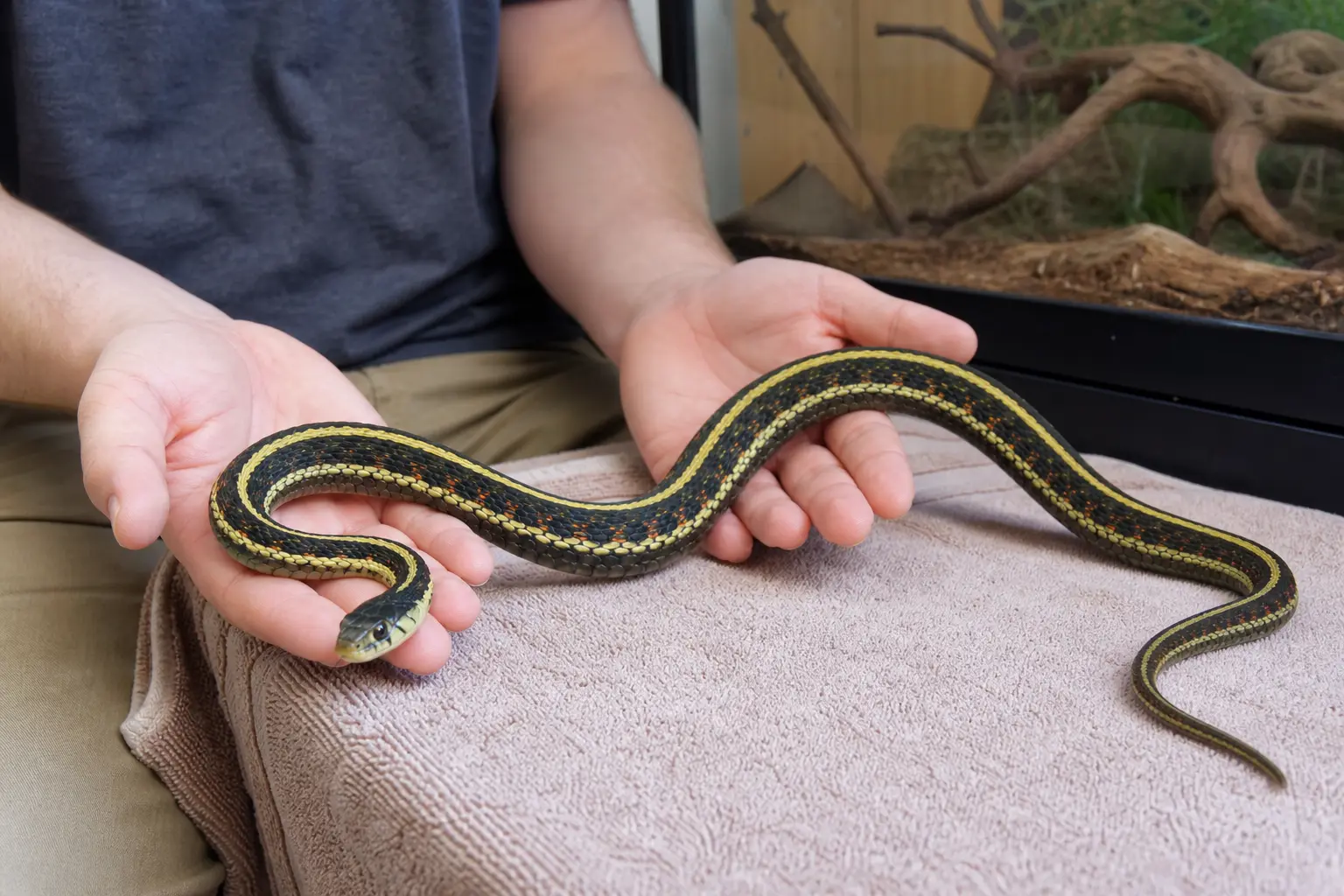
Garter snake · Gentle handling

How do I handle a garter snake safely?

Let a garter snake step onto fully supporting hands, then keep the session short. Stop at the first sign it wants to leave.

Begin with choice and finish before the snake struggles. Quiet observation is often the better interaction.

Use the practical checks
Adult common garter snake with yellow stripes, red side marks, and a clear eye fully supported low over a clean towel during a brief calm handling session.

The short answer

Support the whole body and stop at the first clear no for garter snakes

Let a garter snake step onto fully supporting hands, then keep the session short. Stop at the first sign it wants to leave.

Adult home
At least the snake's full length, with at least one-third that length in width and height; larger for a group
Warm zone
Measured basking zone 28–32°C (82–90°F)
Cool and night
Covered cool end 22–24°C (72–75°F); Heat may switch off when the room stays safely around 16°C (61°F) or warmer; all visible lights off
Humidity
About 50–60%, with a clean humid hide, a submersion-sized water dish, dry land, and ventilation
UVB
Low-output linear UVB measured around UVI 1.0 at basking level, grading to zero in shade; lower for sensitive morphs
Food
A varied whole-prey plan built around thawed rodents, safe low-thiaminase fish, and supplier-raised earthworms

The honest fit

Would the adult routine work in your home?

Do this

  • Work over a low soft surface after the snake has settled.
  • Lift with two points of support and let the body move freely.
  • Keep fresh water and monitor garter snake behavior every day.
  • Record changes so a reptile veterinarian receives useful evidence.

Avoid this

  • Do not chase, pin, grip the neck, or let the body hang from one hand.
  • Do not continue after backing away or frantic escape attempts.
  • Do not copy another reptile species' setup.
  • Do not treat a persistent health change as a shopping problem.
01

Start after settling

Give a new garter snake at least the first week to learn the habitat, find food, and establish hiding places. Begin only when routine behavior and appetite are steady.

Wash and dry your hands, close the room, remove other pets, and work over a low soft surface. Approach slowly from the side rather than dropping a hand from above like a predator.

Adult common garter snake exploring meadow grass beside water with its complete slender body, yellow stripes, red side marks, and alert head in clear view.
02

Let support do the work

For this species, scoop from below, support the whole slender body, keep sessions around 5–10 minutes, and stop if the snake musks or struggles. Keep sessions around 10 minutes at first and return the snake before its body cools or behavior changes.

Never chase repeatedly through the habitat or pin the body. Stop if the snake backs away, jumps, squeaks, bites, freezes, or repeatedly tries to escape. Let it settle before another attempt.

Alert adult common garter snake exploring meadow-like cover beside clean water with its slender dark body, yellow stripes, red side marks, and clear eye in view.
03

Protect the tail and the fall

A fall can injure a snake, so keep its entire body low and continuously supported. Keep hands close together, move slowly, and maintain a clear landing surface without gaps or hard edges.

Use handling mainly for voluntary interaction and brief health checks. Pain, weakness, poor grip, swelling, an injury, or sudden new defensiveness is a reason to stop and consider veterinary advice.

Keep deciding

See the complete care picture

Sources and further reading