

Uromastyx · Gentle handling

How do I handle a uromastyx safely?

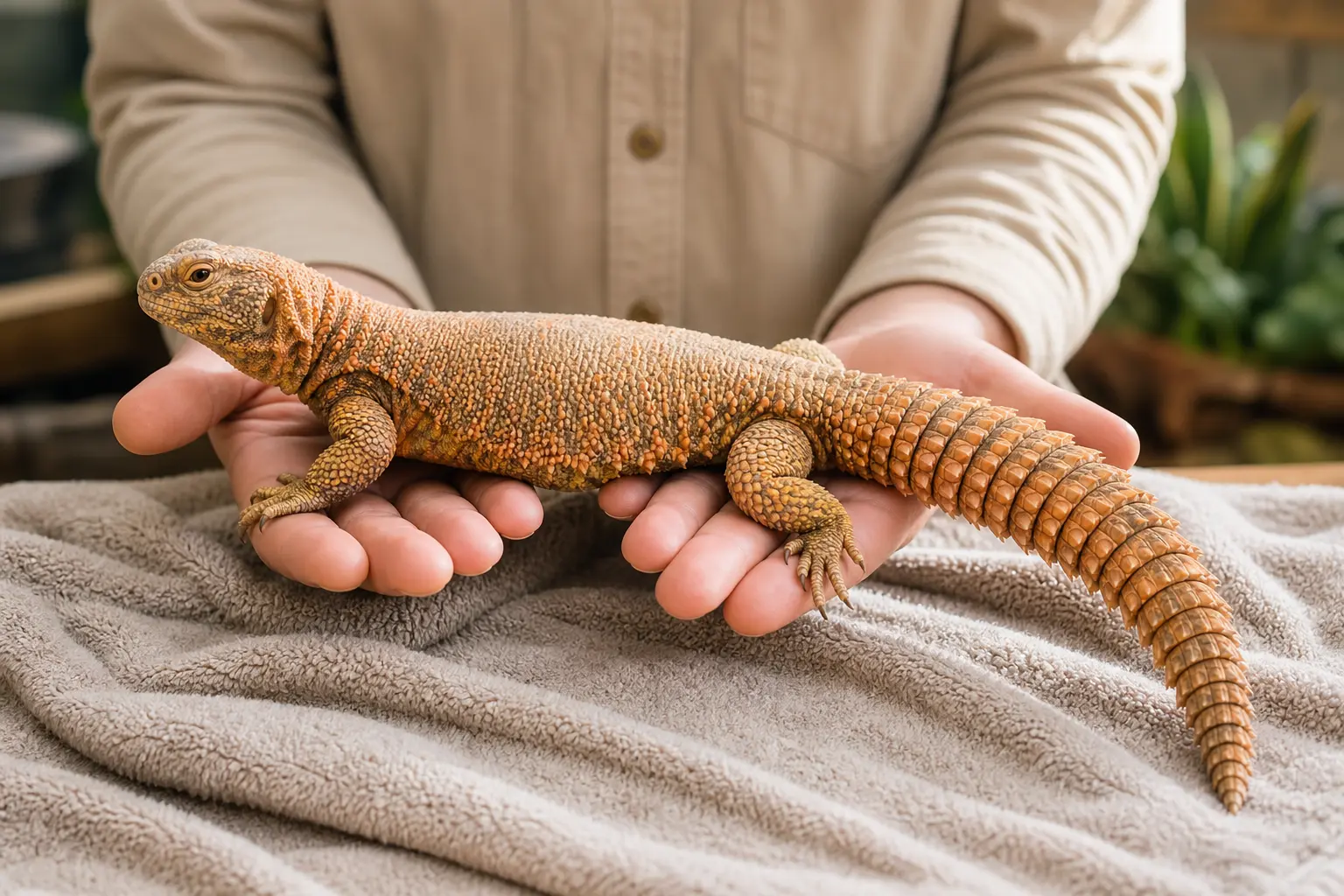
Scoop a uromastyx from below with two hands, support its body and all four legs, and keep it low. Never lift, steer, or restrain this lizard by its armored tail.

The spiny tail is a defense, not a handle. Calm handling begins after the animal settles and ends at the first clear refusal.

Use the practical checks
Adult Moroccan uromastyx held low over a towel with two hands supporting its body and legs while the armored tail remains completely free.

The short answer

Support the whole lizard and leave the tail completely free for uromastyx

Scoop a uromastyx from below with two hands, support its body and all four legs, and keep it low. Never lift, steer, or restrain this lizard by its armored tail.

Adult home
Identify the exact species first; begin at 227 L (60 gal), then scale up substantially for longer species and provide broad floor space
Warm zone
Basking surface about 49°C (120°F); daytime gradient about 27–38°C (80–100°F)
Cool and night
A deep shaded retreat at the cool end; All visible lights off; allow a measured 5–8°C (10–15°F) drop
Humidity
Usually 10–40%, confirmed for the exact species, with dry ventilation, fresh water, and no persistently damp substrate
UVB
Strong measured linear UVB overlapping the broad basking zone, with unobstructed exposure and complete shade
Food
A varied herbivorous menu led by calcium-rich dark greens, grasses, leaves, and flowers, with suitable vegetables, pulses, and seeds in smaller roles

The honest fit

Would the adult routine work in your home?

Do this

  • Work over a low soft surface after the uromastyx has settled.
  • Scoop from below and support the body and all four legs.
  • Keep fresh water and monitor uromastyx behavior every day.
  • Record changes so a reptile veterinarian receives useful evidence.

Avoid this

  • Do not chase, pin, dangle, or lift, steer, or restrain by the tail.
  • Do not continue after backing away or frantic escape attempts.
  • Do not copy another reptile species' setup.
  • Do not treat a persistent health change as a shopping problem.
01

Begin after settling

Give a new uromastyx time to establish basking, hiding, feeding, and normal daytime movement. Start only when the enclosure and appetite are stable.

Wash and dry your hands, close the room, remove other pets, and work over a low towel-covered surface. Approach from the side rather than dropping a hand over the head.

Adult Moroccan spiny-tailed lizard representing the pet uromastyx group, basking beside a rocky retreat with its sturdy body and complete whorled tail in clear view.
02

Lift the whole animal

For this species, scoop from below with both hands, support the body and all four legs, keep the animal low, and never lift, restrain, or steer it by the armored tail. Bring both hands under the body before lifting and allow the tail to rest or move without pressure.

Keep contact brief. Return the lizard as soon as it pulls away, closes its eyes, or lashes its tail.

Alert adult Moroccan uromastyx exploring a spacious dry rocky habitat with its broad head, sturdy orange-tan body, and complete armored spiny tail in view.
03

Let observation be enough

A roomy habitat can support voluntary approaches and brief health checks without daily lifting. Free roaming adds fall, escape, chilling, and hygiene risks.

Pain, burns, weakness, limping, swelling, tail injury, breathing changes, or sudden persistent defensiveness is a reason to stop and seek reptile-veterinary advice.

Keep deciding

See the complete care picture

Sources and further reading