

African fat-tailed gecko · UVB and shade

Does an African fat-tailed gecko need UVB?

African fat-tailed gecko care should include the measured low-output UVB gradient below. Preserve complete shade and switch every light off at night.

The amount reaching the gecko changes with its distance from the lamp and anything positioned between them.

Use the practical checks
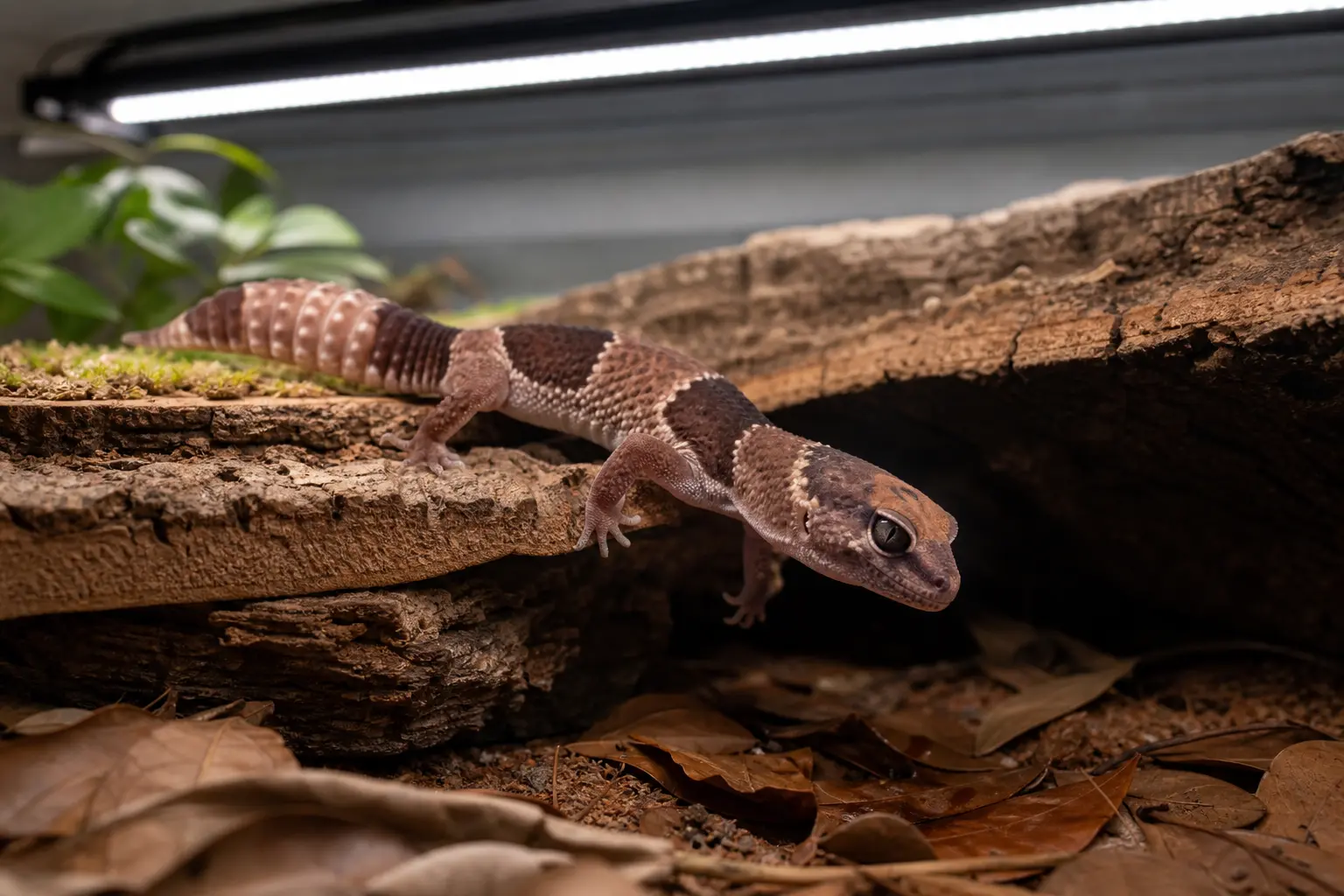
Adult African fat-tailed gecko moving between a gently lit low ledge beneath linear UVB and a fully shaded secure hide.

The short answer

Offer gentle UVB with an immediate route to shade for African fat-tailed geckos

African fat-tailed gecko care should include the measured low-output UVB gradient below. Preserve complete shade and switch every light off at night.

Adult home
Plan about 91 × 46 × 46 cm (36 × 18 × 18 in) or larger for one adult, with useful floor space for covered warm, cool, and humid choices
Warm zone
Daytime warm retreat about 28–30°C (82–86°F)
Cool and night
Covered cool retreat about 25°C (77°F); All visible lights off; measure a nighttime range around 20–25°C (68–77°F) and use guarded non-light heat only when needed
Humidity
About 60% ambient humidity, plus a clean humid hide, fresh water, and ventilation
UVB
Gentle product-specific linear UVB over part of the warm side with complete shade and secure dark retreats
Food
Varied appropriately sized live insects, safely sourced and prepared, with calcium and vitamins used to an individual reviewed plan

The honest fit

Would the adult routine work in your home?

Do this

  • Measure exposure where the gecko can actually sit.
  • Provide an immediate route from light into complete shade.
  • Keep fresh water and monitor african fat-tailed gecko behavior every day.
  • Record changes so a reptile veterinarian receives useful evidence.

Avoid this

  • Do not choose a lamp by percentage without distance guidance.
  • Do not leave visible lighting on overnight.
  • Do not copy another reptile species' setup.
  • Do not treat a persistent health change as a shopping problem.
01

Design light and shade together

For an African fat-tailed gecko, use gentle product-specific linear UVB over part of the warm side with complete shade and secure dark retreats. Group the brighter zone with daytime warmth while preserving dark retreats and foliage or hide cover nearby.

A lamp percentage cannot predict the dose on its own. Follow the fixture maker's distance chart, account for mesh, and measure at the highest place the gecko can actually reach when possible.

Adult African fat-tailed gecko resting alertly on pale cork with its warm brown bands, movable eyelid, clawed toes, and full segmented tail in clear view.
02

Keep the cycle predictable

Run the daytime lighting on a timer for roughly 12 hours, then make the enclosure dark overnight. Replace the lamp on schedule or verify output with an appropriate meter.

Secure or guard fixtures so the gecko cannot contact hot glass or a breakable lamp. After rearranging climbing routes or hides, re-check distance and shade instead of assuming the old setup still applies.

Alert adult African fat-tailed gecko exploring a broad sheltered habitat with warm brown bands, movable eyelids, clawed toes, and a complete plump segmented tail in view.
03

Coordinate food and UVB

UVB, heat, calcium, and the rest of the diet work as one husbandry system. More supplement is not a safe substitute for unmeasured lighting, and more UVB is not automatically better.

Discuss supplement choice with a reptile veterinarian, especially for a red-eyed or unusually light-sensitive morph, a growing juvenile, an egg-producing female, or a gecko showing weakness or skeletal change.

Keep deciding

See the complete care picture

Sources and further reading